How to Play Teen Patti: Full Rules for Beginners
Teen Patti — literally "three cards" in Hindi, and often written 3 Patti — is the card game that lights up Diwali nights and family gatherings across India. It's quick, social, and built almost entirely on nerve. This guide takes you from a fresh deck to your first full round, in plain language, with no prior card-game experience needed.
The aim of the game
Everyone is dealt three cards, and you bet round after round on who is holding the strongest three-card hand. Players drop out as the stakes rise, and the last person standing — or the winner of a final face-off — scoops the whole pot. You don't need the best cards to win; you need to convince everyone else that you have them.
What you need
- 3 to 6 players. It works with more, but the deck runs thin past six or seven.
- One standard 52-card deck — remove the jokers.
- Chips, coins, or counters to bet with. Decide before you start what they're worth.
The words you'll hear (learn these 7)
Teen Patti has its own little vocabulary. Get these and the rest is easy:
| Term | Meaning |
|---|---|
| Boot (ante) | The fixed amount everyone puts in to start the pot. |
| Pot | The pile of chips in the middle that the winner takes. |
| Blind | A player who bets without looking at their cards. |
| Seen (chaal) | A player who has looked at their cards; their bet is called a chaal. |
| Pack / fold | Giving up your hand and leaving the round. |
| Show | The final face-off where two players compare cards. |
| Sideshow | A request to privately compare cards with the player before you. |
One round, step by step
Here's the whole flow of a single hand at a glance:
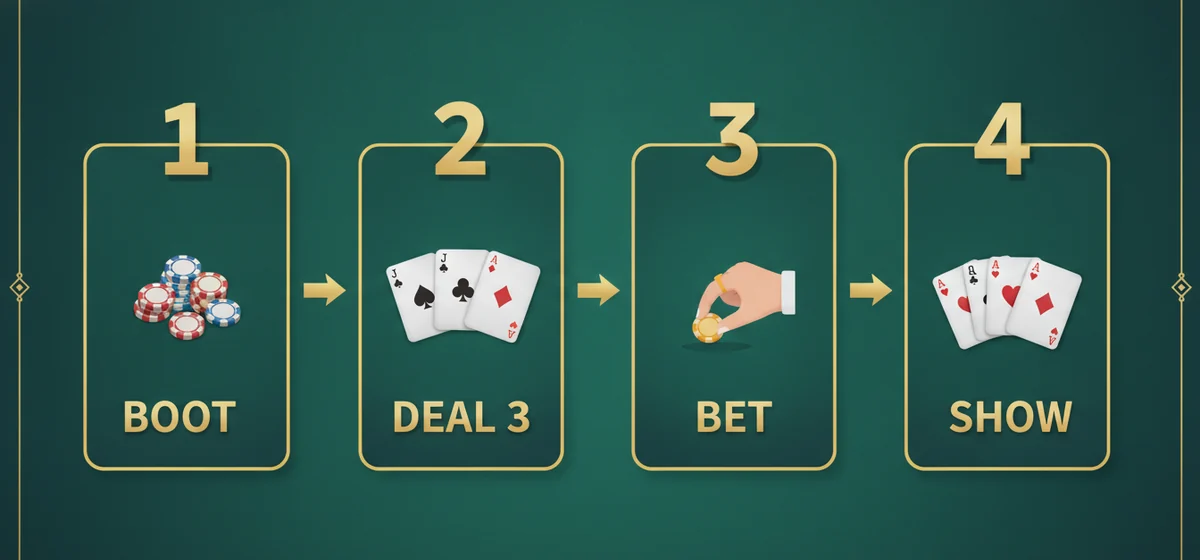
1. Everyone puts in the boot
Before any cards are dealt, each player puts an equal boot into the centre. That starting pile is the pot — the prize everyone is now playing for.
2. Deal three cards each
The dealer gives everyone three cards, face down, one at a time, going clockwise. Don't rush to peek — whether you look or not is a real decision (see the next step).
3. Bet your way round the table — blind or seen
Starting to the dealer's left, players take turns. On your turn you either bet to stay in, or pack (fold). The twist that makes Teen Patti special is the blind vs seen choice:
- Playing blind — you haven't looked at your cards. You bet the current stake (or up to twice it), and crucially you bet less than seen players. A bold blind player is cheap to keep in and hard to read.
- Playing seen — you've looked. You now must bet a chaal of at least double the current stake (up to four times it). You know more, so you pay more.
4. Sideshow (optional)
If you're seen, on your turn you can ask the previous seen player for a sideshow — a private comparison. If they accept, you two compare cards secretly and whoever is lower must pack. They can also refuse. It's a way to quietly knock someone out without a full show.
5. The show
Eventually everyone packs except two players. Now one of them pays for the show: both reveal their three cards, and the higher-ranked hand wins the entire pot. (If the two are tied, the player who did not pay for the show usually wins — agree on this before you start.)
Teen Patti hand rankings (highest to lowest)
You can't bet well if you don't know what beats what. Here is the full order — and note the one rule that trips up poker players: in Teen Patti a sequence beats a color (flush).
| Rank | Hand | What it is |
|---|---|---|
| 1 (best) | Trail / Trio | Three of the same rank, e.g. A-A-A. Three aces is the top hand. |
| 2 | Pure Sequence | Three in a row, same suit, e.g. 7♥ 8♥ 9♥. |
| 3 | Sequence (Run) | Three in a row, mixed suits, e.g. 7♥ 8♠ 9♦. |
| 4 | Color | Three of the same suit, not in a row, e.g. 2♠ 7♠ J♠. |
| 5 | Pair | Two cards of the same rank, e.g. K-K-4. |
| 6 (worst) | High Card | None of the above; the highest single card decides. |
Want the deep version — how sequences rank against each other, which trio is strongest, and how ties are broken? Read our full Teen Patti sequence and hand rankings guide.
A quick sample hand
Four friends boot in 10 chips each, so the pot starts at 40. Priya plays blind and bets 10 without looking. Rahul looks — he's seen — and holds 9♥ 8♠ 7♦ (a sequence), so he confidently bets a chaal of 20. The third player packs. Priya, still blind and cheap, calls again. Finally Priya looks: she has a pair of kings. She bets, Rahul matches, and Priya pays for the show. A sequence beats a pair, so Rahul takes the pot — a tidy reminder that the brave blind bet only pays off when the cards (eventually) back it up.
Card games are more fun with skill If you enjoy the table but want a game you can actually get better at, try free Rummy — no signup, no money. Play Rummy free →Want to mix it up?
Once the basic game feels natural, the fun really starts: there are dozens of Teen Patti variations like Muflis (lowest hand wins), AK47 (wild cards) and 999. And if you want to actually start winning more often, our Teen Patti tips and tricks cover when to play blind, when to pack, and how to use the sideshow.
Frequently Asked Questions
Is Teen Patti the same as 3 Patti?
Yes. "Teen Patti" means "three cards" in Hindi, and "3 Patti" is just another way to write it. Same game, same rules.
How many cards does each player get?
Three, dealt face down from a standard 52-card deck with the jokers removed. The best three-card hand wins.
What's the difference between blind and seen?
A blind player bets without looking and bets a smaller amount. A seen player has looked at their cards and must bet at least double the stake (a chaal). Information costs money.
Which is the highest hand in Teen Patti?
A trail (three of a kind), with three aces being the strongest. The order is trail, pure sequence, sequence, color, pair, then high card. Note that a sequence beats a color — the opposite of poker.
Is Teen Patti a game of skill or luck?
Mostly luck, with a layer of betting and bluffing skill on top. For a card game where skill genuinely decides who wins, see Rummy vs Teen Patti.