How to Play Rummy: A Complete Beginner's Guide
Rummy is one of the easiest card games to learn and one of the hardest to put down. If you can match cards by rank or line them up by suit, you already know the heart of it. This guide walks you through every step — dealing, melds, scoring and winning — and you can practice in our free game whenever you like.
📖 इस गाइड को हिंदी में पढ़ें → (Read this guide in Hindi)
Play Rummy free while you read No signup, no download — open the game in another tab and try each step as you learn it. Play Rummy →The Goal of the Game
The aim of Rummy is simple: be the first player to get rid of all the cards in your hand. You do this by arranging cards into melds and placing them on the table, then discarding whatever you can't use.
Setting Up: How Many Cards?
Rummy uses a standard 52-card deck. The number of cards you're dealt depends on how many people are playing:
- 2 players: 10 cards each
- 3 or 4 players: 7 cards each
The remaining cards form a face-down pile called the stock. The top card is flipped over beside it to start the discard pile.
That 7-and-10 split is the classic Western game. In India, “rummy” almost always means 13-card Indian Rummy — dealt 13 cards each from two decks with jokers, and needing a pure sequence to declare. The steps below apply to both; for that version see our 13-card Indian Rummy rules and the wider Indian Rummy guide.
Rummy Melds: Sets and Runs
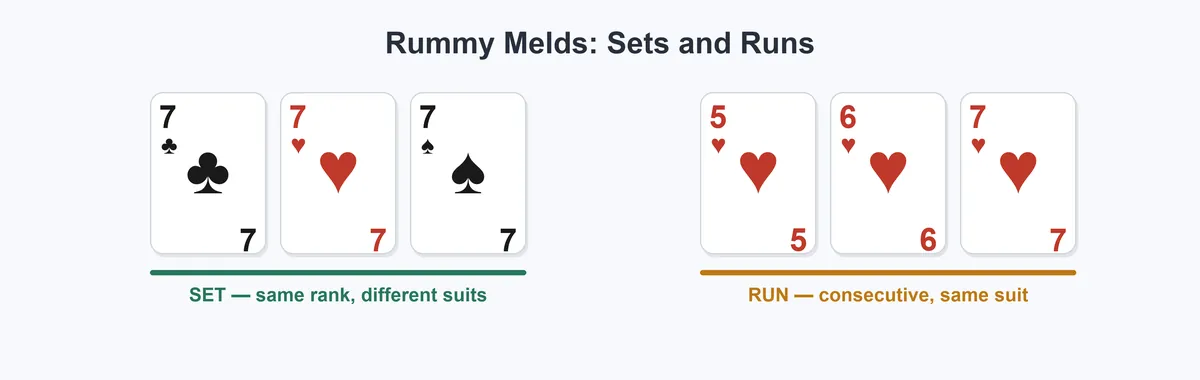
Everything in Rummy is built from two kinds of meld:
- Set — three or four cards of the same rank (for example, three Queens).
- Run — three or more cards of the same suit in sequence (for example, 5-6-7 of hearts).
Aces are low, so a run can start Ace-2-3, but it can't wrap around from King back to Ace.
A quick check of what does and doesn’t count:
| Cards | Valid? | Why |
|---|---|---|
| 7♠ 7♥ 7♦ | Yes — set | Three of a kind, different suits |
| 5♥ 6♥ 7♥ | Yes — run | Consecutive cards, all one suit |
| 5♥ 6♠ 7♥ | No | A run must be a single suit |
| A♣ 2♣ 3♣ | Yes — run | The ace is low, so A-2-3 works |
| K♣ A♣ 2♣ | No | The ace can’t wrap from King to 2 |
The Four Steps of a Rummy Turn
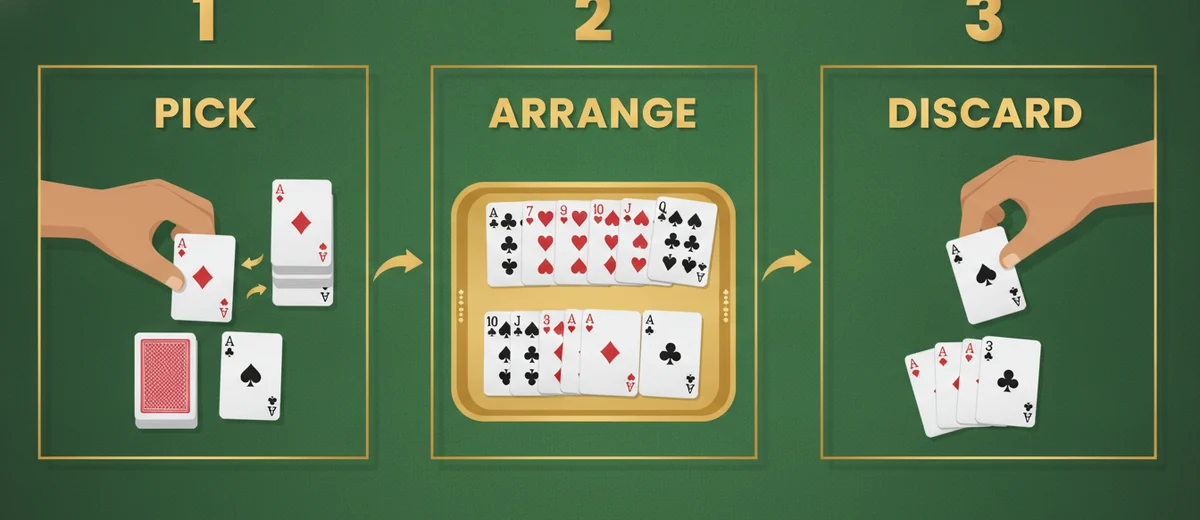
On your turn you follow the same four steps in order:
- Draw one card — either the unknown top of the stock or the visible top of the discard pile.
- Meld any sets or runs you can lay down (you may lay more than one).
- Lay off single cards onto melds already on the table; once a meld is down, anyone can extend it.
- Discard one card to end your turn.
Your First Hand, Step by Step
Here’s a two-player hand to make it concrete. You’re dealt ten cards: 4♠ 5♠ 6♠ · 9♥ 9♦ · Q♦ J♦ · K♣ 3♣ 8♥. Straight away you can see a run (4♠-5♠-6♠) and two pairs building — the 9s, and Q♦-J♦ wanting a 10♦.
- Turn 1. You draw the 9♠ from the stock, completing the set 9♥-9♦-9♠. You lay down both the run and the set — six cards on the table — leaving Q♦ J♦ K♣ 3♣ 8♥ in hand. You discard the 3♣, your least useful card.
- Turn 2. An opponent discards the 10♦. You take it, because Q♦-J♦-10♦ is a run. You meld it and now hold just K♣ 8♥, then discard the 8♥.
You’re one card — the K♣ — from going out. That is a whole hand in two turns: draw, spot the meld, lay it down, and shed what you can’t use.
Drawing: Stock or Discard Pile?
Every turn starts with one real decision. The stock is a mystery card that keeps your plan hidden. The discard pile is a known card, but taking it tells everyone what you’re collecting. Take a discard only when it clearly finishes or extends a meld — otherwise the small edge isn’t worth showing your hand.
Laying Off: Adding to Melds
Once any meld is on the table, you can lay off single cards onto it on later turns. If a run of 5♥-6♥-7♥ is down, you can add the 4♥ or 8♥; onto a set of three 9s you can add the fourth 9. Laying off is the fastest way to empty an awkward hand — and in basic Rummy you can lay off onto anyone’s melds, not just your own.
How Rummy Scoring Works
When a player gets rid of all their cards, the round ends. The winner scores the value of the cards left in everyone else's hands:
- Face cards (J, Q, K) = 10 points
- Aces = 1 point
- All other cards = their face value
Because your unplayed cards become points for someone else, the lesson is clear: meld early and don't sit on high cards.
Those values cover basic Rummy. Points Rummy, Pool, Deals and Rummy 500 each count a little differently — our rummy scoring guide breaks down every format with worked examples.
Going Rummy
If you get rid of your entire hand in a single turn without ever having melded or laid off before, you've "gone Rummy" — and your points for that round are doubled. It's risky but spectacular.
Common Beginner Mistakes
- Hoarding high cards. An unmelded King is 10 points against you — let big cards go early unless they’re close to a meld.
- Mixing suits in a run. 5♥ 6♠ 7♥ is not a run; every card must share one suit.
- Trying to wrap the ace. K-A-2 is never a run — the ace is low in basic Rummy.
- Broadcasting your plan. Pulling cards from the discard pile tells opponents exactly what you’re collecting.
- Declaring without a pure sequence (13-card game). An invalid declaration can cost you the full 80 points.
Quick Tips to Win More
- Discard high cards you can't use before they cost you.
- Watch what opponents pick up from the discard pile and avoid feeding them.
- Keep flexible middle cards — they fit into more runs.
- Lay off aggressively to empty your hand faster.
Where to Go Next
Once the basic game feels natural, branch out: the two-player duel of Gin Rummy, the score-to-500 twist of Rummy 500, or a multi-round contract game like Shanghai Rummy. Playing in India? Start with our 13-card Indian Rummy rules.
Ready to play? Put it into practice now against smart opponents in Points, Pool or Deals formats. Play Rummy free →Frequently Asked Questions
How many cards do you get in Rummy?
Two players get ten cards each; three or four players get seven cards each. The rest form the stock.
What's the difference between a set and a run?
A set is three or four cards of the same rank in different suits. A run is three or more cards of the same suit in consecutive order.
How do you win at Rummy?
Be the first to get rid of every card by melding, laying off and discarding your last card.
What's the difference between Rummy and Gin Rummy?
In Rummy you lay melds on a shared table. In Gin Rummy melds stay hidden and you end the hand by knocking once your deadwood is low enough.