Gin Rummy for Dummies: Learn the Whole Game in 10 Minutes
If someone told you Gin Rummy is complicated, they were wrong. It is one of the easiest card games in the world once you stop reading rulebooks and just see it once. This guide skips the jargon: we'll go from "I've never held a card" to playing a full hand — with pictures for every step — in about ten minutes.
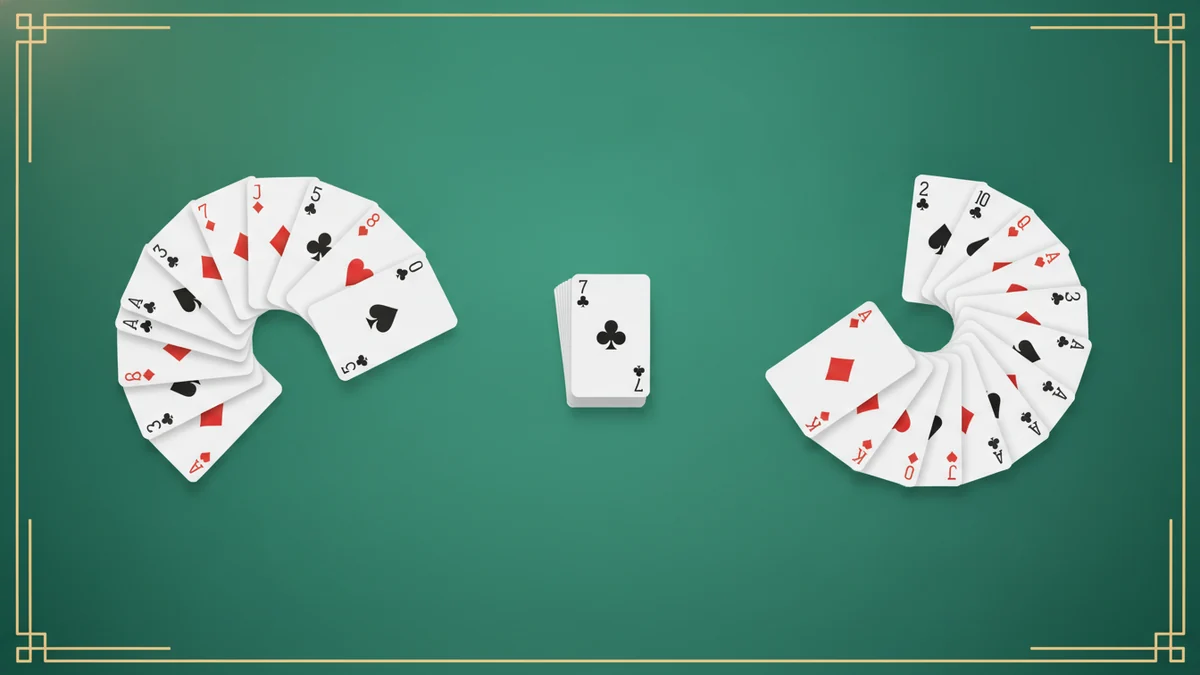
The whole game in one sentence
Here it is, the entire point of Gin Rummy: tidy up your 10 cards into matching groups faster than the other person, then say "stop." That's it. Everything below is just the detail of how you do that. Read that sentence again before you carry on — if you remember nothing else, remember that.
What you need
- Two players. Gin Rummy is built for exactly two. (Got three people? See Gin Rummy with 3 players instead.)
- One standard 52-card deck. No jokers — take them out.
- A flat surface and about ten minutes. Or just open the free game and skip the shuffling.
Step 1: Set up the table
Shuffle and deal 10 cards to each player, one at a time. Put the rest of the deck face down in the middle — that pile is called the stock. Flip the top card of the stock face up next to it to start the discard pile. Your ten cards are yours to look at; keep them hidden from your opponent.
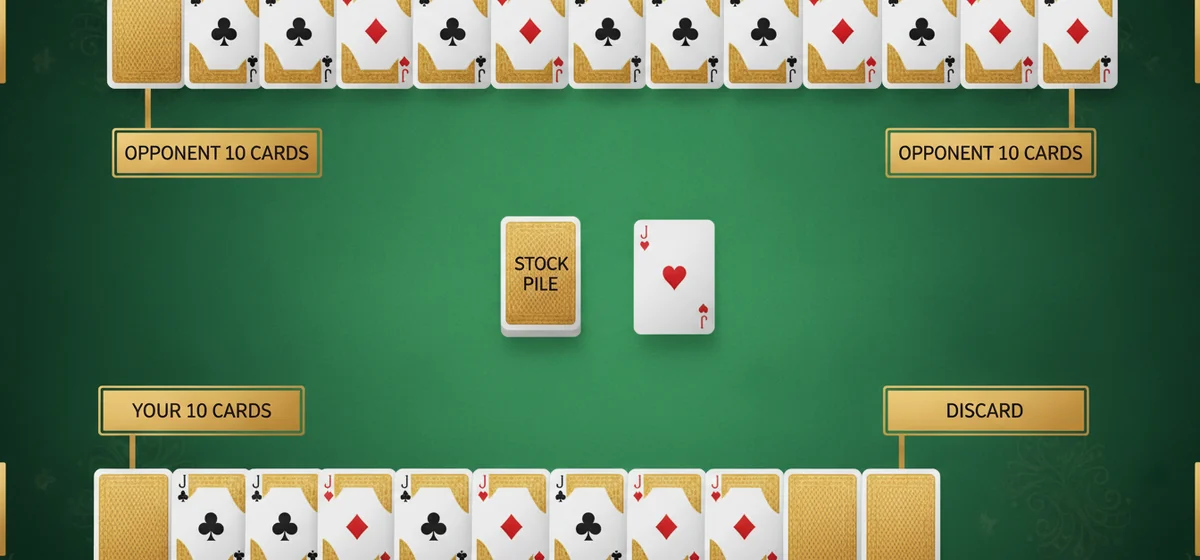
Step 2: Learn the only two groups that matter
"Tidying up" your hand means building melds. A meld is just a valid group of cards, and there are only two kinds. Learn these two pictures and you've learned 80% of the game:
- A set — three or four cards of the same number, e.g. 8♠ 8♥ 8♣.
- A run — three or more cards of the same suit in a row, e.g. 4♦ 5♦ 6♦.
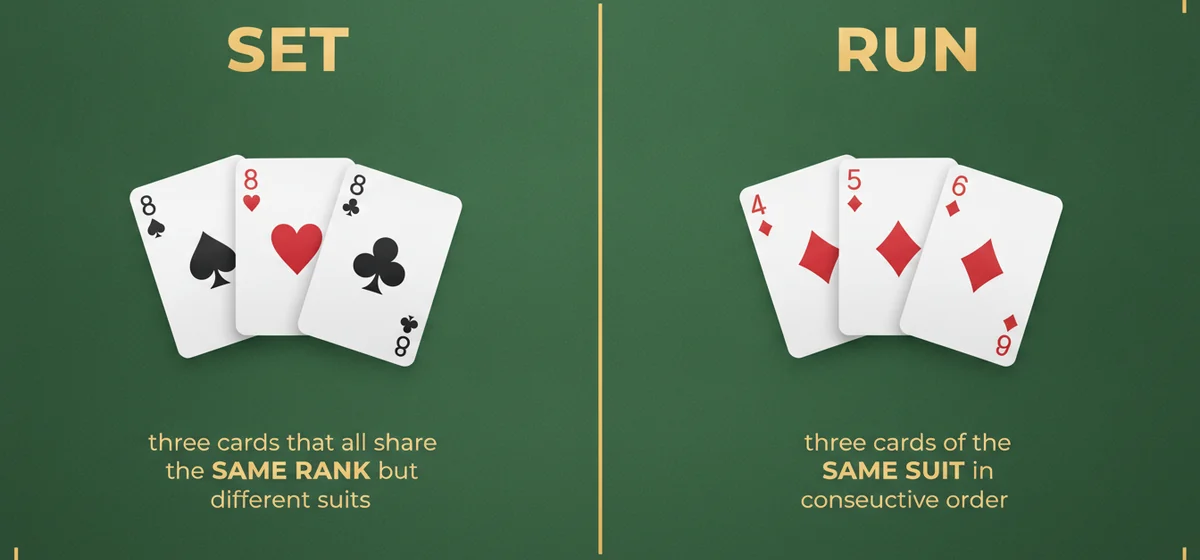
Two small rules to bank: a card can only live in one group at a time, and Aces are low. So A-2-3 is a fine run, but Q-K-A is not.
Step 3: Know what the leftovers cost
Any card that isn't in a set or run is called deadwood — leftover junk that counts against you. Each card is worth points:
| Card | Points |
|---|---|
| Ace | 1 |
| 2 to 10 | Face value (a 7 is 7 points) |
| Jack, Queen, King | 10 each |
So a leftover King hurts (10 points) far more than a leftover 3. This single fact quietly drives every good decision you'll make: when in doubt, throw the big leftover cards away first.
Step 4: Take your turn (it's only two actions)
A turn in Gin Rummy is gloriously simple. You always do exactly two things, in order:
- Draw one card — either the mystery card on top of the stock, or the visible top card of the discard pile. You now hold 11 cards.
- Discard one card — place any one card face up on the discard pile. You're back to 10.
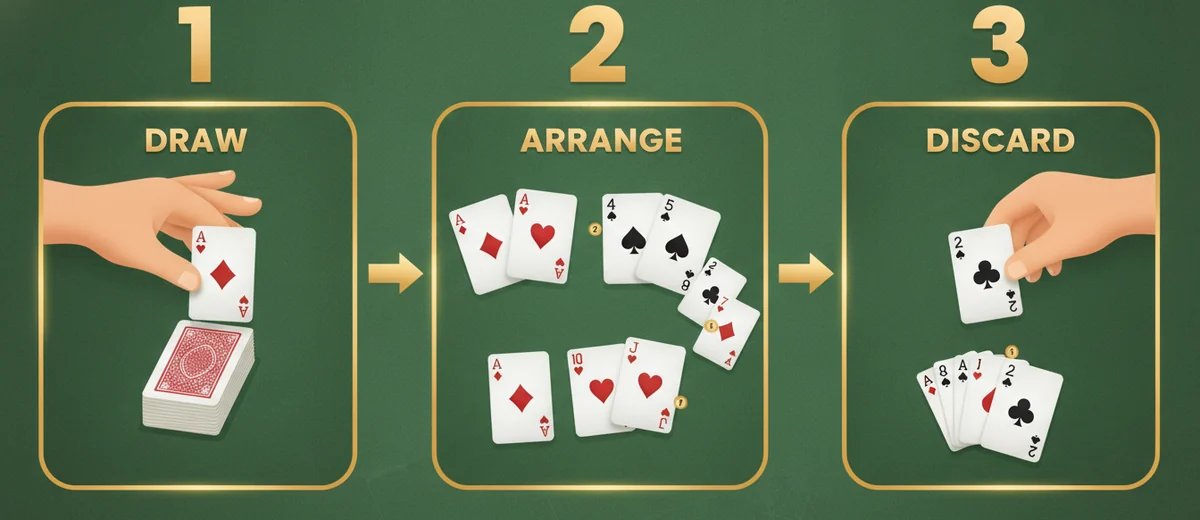
That middle step — quietly re-sorting your hand in your head — is where the whole game lives. Unlike basic Rummy, you do not lay your groups on the table as you go. Everything stays secret in your hand until someone ends the round.
Step 5: End the hand — "knock" or "go gin"
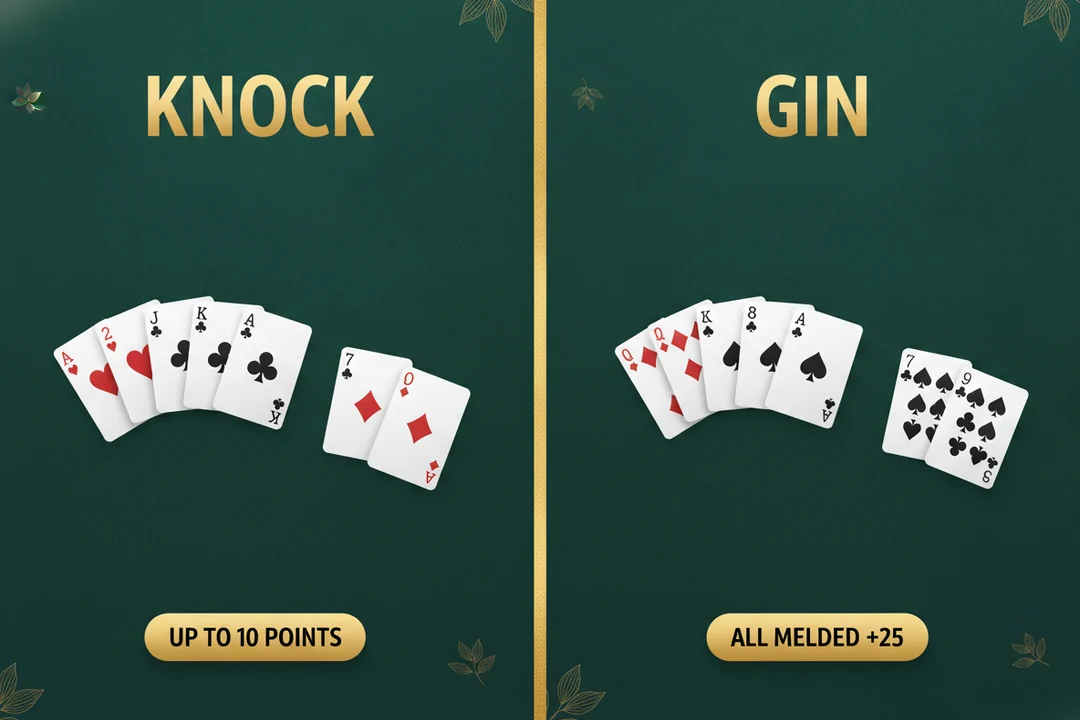
You don't play until you run out of cards. Instead, the moment your hand is tidy enough, you end it. There are two ways:
Knocking (the normal way)
When your deadwood adds up to 10 points or less, you may "knock" (literally tap the table, or click the knock button online). You lay your hand down, groups separated from leftovers, and the scoring begins.
Going gin (the showy way)
If every single card is in a group and you have zero leftovers, you've "gone gin." It earns a juicy 25-point bonus and can't be fought back against.
Step 6: Score the hand (the easy version)
Once someone ends the hand, you just compare leftover points. There are only three outcomes, and they're friendlier than they sound:
- You knocked and won: you score the difference between your opponent's deadwood and yours. They had 14 left, you had 6? You score 8.
- You went gin: you score all of your opponent's leftover points plus a 25-point bonus. This is the big swing.
- You got undercut: if you knock but your opponent's leftovers are equal to or lower than yours, they flip it on you and score the difference plus a 25-point bonus. This is exactly why a greedy, high knock is dangerous.
One nice detail when someone knocks (but not on a gin): the other player can lay off — slot their own leftover cards onto the knocker's groups to shrink their count. Keep dealing fresh hands and adding scores until someone reaches 100 points. That player wins. If you want the full point-by-point breakdown with bonuses, see our Gin Rummy scoring guide.
You now know the whole game Seriously — that's all of it. Go play a hand right now and it'll click in two minutes. Play Gin Rummy free →Your very first hand, played out
Let's walk through one short hand so the pieces connect. Imagine you're dealt:
4♦ 5♦ 8♠ 8♥ 8♣ K♠ Q♥ 2♣ 7♦ 9♠
First, sort it in your head. You already have a ready-made set (8♠ 8♥ 8♣) and the start of a run (4♦ 5♦ — a 3♦ or 6♦ would finish it). Your leftovers are K, Q, 2, 7♦, 9 — and notice the King and Queen are 10 points each. That's where the danger is.
On your turn you draw the stock and get a 6♦. Lovely — now 4♦ 5♦ 6♦ is a real run. You discard the K♠, dumping 10 points of leftover risk. Your deadwood just dropped from 29 to 19.
A few turns later you draw a 3♦, extending the run to 3♦-4♦-5♦-6♦, and you've already shed the Queen and the 9. Now your only leftovers are the 2♣ and the 7♦ — just 9 points. That's under 10, so you knock. Your opponent is sitting on 17 points of deadwood, can only lay off one card to drop to 13, and you score the difference: 4 points banked. That is a completely normal, winning hand — nothing fancy, just tidying up and throwing away the heavy cards.
Five beginner mistakes (and the fix)
- Hoarding face cards. Kings and Queens are 10-point anchors. Unless they're about to form a group, throw them early.
- Chasing gin every time. Gin is great, but waiting for it gets you undercut. Bank the knock.
- Feeding your opponent. If they just grabbed the 7♥ from the discard pile, don't hand them the 8♥ or 6♥ next. Watch what they take.
- Ignoring the discard pile. Taking a face-up card tells your opponent what you're building — but it also instantly completes a group. Use it when the trade is worth it.
- Keeping rigid cards. A 6 or 7 can slot into many runs; an Ace or King can't. Middle cards are flexible — hold them, dump the corners.
The 10 words you'll hear
| Word | What it means |
|---|---|
| Stock | The face-down draw pile in the middle. |
| Discard pile | The face-up pile you throw cards onto. |
| Meld | A valid group — a set or a run. |
| Set | 3–4 cards of the same number. |
| Run | 3+ cards of the same suit in sequence. |
| Deadwood | Your leftover, unmatched cards (and their points). |
| Knock | Ending the hand with 10 or fewer deadwood points. |
| Gin | Ending with zero deadwood (+25 bonus). |
| Lay off | Adding your leftovers to the knocker's groups. |
| Undercut | Beating the knocker by having equal or lower deadwood (+25 bonus). |
Frequently Asked Questions
Is Gin Rummy hard to learn?
Not at all. If you can sort cards into matching groups, you can play. There's really only one decision each turn — which card to keep and which to throw — so most people understand a full game after one or two practice hands.
How many cards do you start with?
Each of the two players is dealt 10 cards. One card is flipped face up to start the discard pile and the rest become the face-down stock.
Can I play Gin Rummy with 3 or 4 people?
Gin Rummy is really a two-player game. For more players, try our guide to Gin Rummy with 3 players or classic Rummy, which seats more people comfortably.
What's the difference between Rummy and Gin Rummy?
In Rummy you lay your groups on the table as you build them. In Gin Rummy everything stays hidden and the hand ends in one move — a knock. We break it all down in Rummy vs Gin Rummy.
What does "going gin" actually win you?
Going gin means zero leftover cards. You score every point of your opponent's deadwood plus a 25-point bonus, and they can't lay off any cards against you — the biggest single swing in the game.