13-Card Indian Rummy Rules: How to Play & Win
13-card Rummy — the version played across India and the most popular form of the game worldwide — takes the familiar sets-and-runs idea and adds two strict rules that give it real depth: you must build a pure sequence, and you finish by making a single valid declaration. Get those two right and the rest falls into place. Here’s the complete guide.
Practice sequences and sets free Drill the melding skills behind 13-card Rummy in our browser game — no signup, no download. Play Rummy →The Goal
13-card Indian Rummy is played by 2 to 6 players using two standard 52-card decks plus jokers. Each player is dealt 13 cards, and the aim is to arrange all 13 into valid sequences and sets — then declare before anyone else. The catch: your arrangement must follow the pure-sequence rule below, or it doesn’t count.
Sequences and Sets
Pure sequence (the must-have)
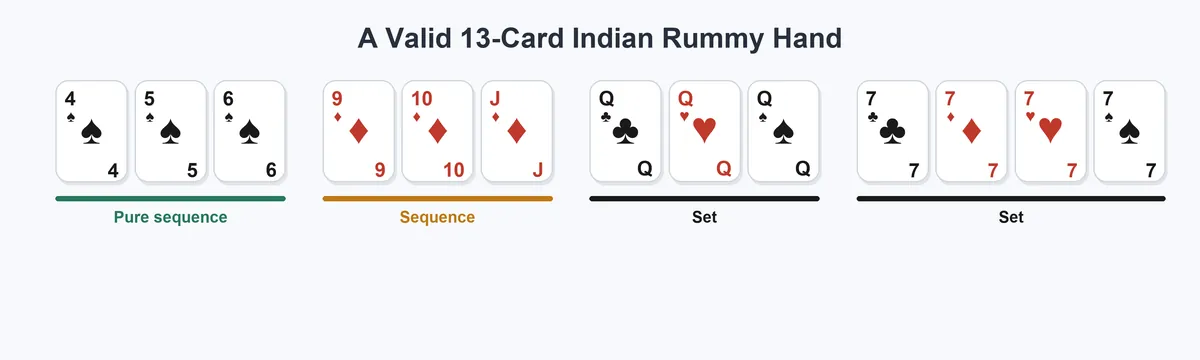
A pure sequence is three or more consecutive cards of the same suit with no joker used — for example 5♥ 6♥ 7♥. Every valid declaration needs at least one pure sequence. Most rule sets require two sequences total, at least one of which is pure.
Impure sequence
An impure sequence is a run of the same suit that uses a joker to fill a gap, e.g. 5♠ 🃏 7♠ (joker standing in for 6♠).
Set
A set is three or four cards of the same rank in different suits, e.g. 9♥ 9♠ 9♣. Jokers can complete a set too. A set can’t contain two cards of the same suit.
Jokers
Indian Rummy uses two kinds of joker:
- Printed joker — the joker card from the deck.
- Wild joker — a random card chosen each game; all four suits of that rank act as jokers.
Jokers can substitute for any card in a set or impure sequence — but never in a pure sequence.
How a Turn Works
- Draw one card from the closed deck (face down) or the open pile (the discards).
- Arrange your hand into sequences and sets, working toward a valid declaration.
- Discard one card to the open pile, returning to 13 cards.
When all 13 cards form valid groups, you place your final card in the "finish" slot and declare.
A Valid Declaration
To win, your 13 cards must be split into valid groups that satisfy all of these:
- At least two sequences, and
- at least one of them is a pure sequence, and
- every remaining card belongs to a valid sequence or set.
Scoring and Penalties
The winner scores 0. Everyone else is penalised the point value of the cards not in a valid group:
| Card | Points |
|---|---|
| Ace, King, Queen, Jack | 10 each |
| 2 through 10 | Face value |
| Joker | 0 |
- Wrong declaration (e.g. no pure sequence): full 80-point penalty.
- First drop (leaving before your first turn): typically 20 points.
- Middle drop (leaving mid-game): typically 40 points.
- Any hand’s penalty is capped at 80 points.
Lowest total wins. For a deeper look at how points work across formats, see our Rummy scoring guide.
Strategy: How to Win 13-Card Rummy
- Build your pure sequence first. Without it, you can’t declare and you risk the full 80-point penalty — make it priority one.
- Don’t waste jokers on pure sequences. Save them for sets and impure runs where they’re actually allowed.
- Drop early with a bad hand. A 20-point first drop beats an 80-point disaster.
- Discard high cards you can’t place — an unmatched King is 10 points of risk.
- Watch the open pile to read what opponents are collecting and avoid feeding them.
Frequently Asked Questions
How many cards in 13-card Indian Rummy?
Each player gets 13 cards. The game uses two standard decks plus printed jokers, for 2 to 6 players.
What is a pure sequence?
Three or more consecutive cards of the same suit with no joker. Every valid declaration must include at least one.
What happens if I declare without a pure sequence?
It’s an invalid declaration and you take the full 80-point penalty, even if every other card is arranged.
Can a joker be used in a pure sequence?
No. Jokers are only allowed in sets and impure sequences. A pure sequence must be all natural cards.
How is 13-card Rummy different from basic Rummy?
It uses two decks, deals 13 cards, requires a pure sequence, and ends with a single valid declaration rather than melding card by card. Compare it with our basic Rummy guide.