Rummy 500 Rules: How to Play, Score & Win
Rummy 500 — also called 500 Rum or Pinochle Rummy — is the most-played rummy variant in North America, and it rewards a very different instinct from basic rummy. You don’t just race to empty your hand; you score the points inside every meld you lay down, and you can reach deep into a fanned discard pile to grab a card you want. Below: the deal, a full turn, that signature discard rule, card values, scoring with a worked example, and how the game shifts from 2 players up to 8.
Practice your melding on RummyFun Drill sets, runs and smart discards in our free browser Rummy game before your next 500 session. Play Rummy free →What Makes Rummy 500 Different
Basic rummy is a race: the first player to meld their whole hand ends the round and the losers count up what they’re caught holding. Rummy 500 keeps the sets-and-runs core but changes the goal. Here you bank the point value of every card you meld or lay off, hand after hand, until someone’s running total hits 500. Being first out still matters, but a small hand of melds can lose to a slower player who put more points on the table.
That single change pulls in two more rules that give the game its character: a discard pile you can dig into, and scores that can drop below zero. It sits in the melding branch of the rummy family alongside classic Rummy and the contract games — and it’s nothing like the chip-and-board game Michigan Rummy, which shares the name but not the mechanics.
Players, Decks & How Many Cards You Deal
Rummy 500 works for 2 to 8 players and plays best with 3 to 5. The deck you need depends on how many are at the table:
| Setup | Detail |
|---|---|
| Players | 2–8 (best with 3–5) |
| Deck | 52 cards + 2 jokers (54) for 2–4 players; two decks (108) for 5–8 |
| Cards dealt | 13 each (2 players) · 7 each (3+ players) |
| Discard pile | Fanned out, so any card stays reachable |
| Goal | First to a running total of 500 points |
Deal one card at a time, clockwise. The undealt cards become a face-down stock, and the top card is flipped to start the discard pile. The two jokers are wild — a joker stands in for any card, but once you meld it as, say, the 8♣, it can’t later become something else.
A Full Turn of Rummy 500, Step by Step
- Draw. Take the top card of the stock, or take from the discard pile (see the next section for the multi-card rule).
- Meld. Lay any new sets and runs face up in front of you. A set is three or four cards of the same rank in different suits; a run is three or more cards of the same suit in sequence.
- Lay off. Add cards to melds already on the table — yours or an opponent’s. Anything you lay off scores for you, not the person who started the meld.
- Discard. End your turn with one card, placed so the pile stays spread. If you drew only the top discard this turn, you must discard a different card.
Melding and laying off are optional — you can draw and discard with no melds at all. And if you manage to meld or lay off every card in your hand, you go out with no final discard needed, ending the hand on the spot.
Taking More Than the Top Discard (the 500 Rum signature)
This is the rule that separates 500 Rum from every basic rummy game, and the one new players fumble most. The discard pile is fanned, so you can see every card in it. You may reach for a card buried deep in the pile — but there’s a price:
- You must take every card sitting on top of the one you want.
- You must immediately meld the deepest card you took (or lay it off onto an existing meld) on this same turn.
- All the other cards you scooped up go into your hand.
Worked example: is the dive worth it?
Say the fanned discard pile looks like this, and you’re holding 7♣ 8♣:
| Depth | Card in pile |
|---|---|
| Top | K♠ |
| 2nd | 9♥ |
| 3rd | 6♣ |
| Bottom you want | 5♣ |
You want the 5♣. To reach it you take all four cards (K♠, 9♥, 6♣, 5♣). You immediately meld the deepest one as part of a run: 5♣-6♣-7♣-8♣, using the 6♣ you also picked up plus the 7♣ and 8♣ already in your hand. That run is worth 5 + 6 + 7 + 8 = 26 points. The K♠ and 9♥ land in your hand.
Good deal? Mostly — but you’re now stuck holding a K♠ worth 10 points that you’ll lose if you can’t place it before someone goes out. That trade-off is the whole game: dig only when the buried card earns more than the junk you’re forced to carry.
Card Values and a Worked Scoring Example
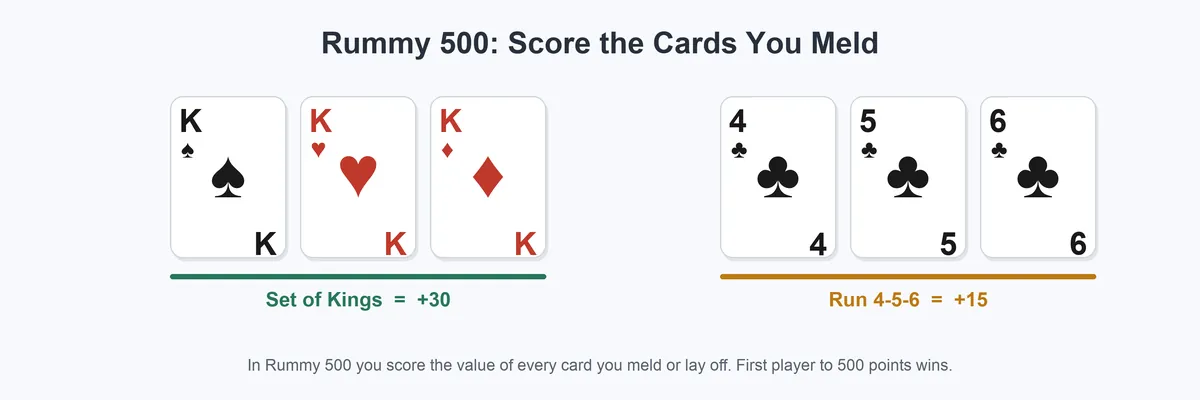
Points are the same whether a card scores for you on the table or against you in your hand:
| Card | Points |
|---|---|
| Ace, high (Q-K-A run or in a set) | 15 |
| Ace, low (A-2-3 run) | 1 |
| Joker (wild) | 15 |
| King, Queen, Jack, 10 | 10 each |
| 2 through 9 | Face value |
The ace bends both ways: A♥-2♥-3♥ is a valid low run (the ace counts 1), and Q♠-K♠-A♠ is a valid high run (the ace counts 15). It can’t wrap around, so K-A-2 is never a run.
Scoring one hand, start to finish
An opponent goes out. On the table you have melded a club run 5♣-6♣-7♣-8♣ (26), a set of K♠-K♥-K♦ (30), and you laid off a Q♦ onto someone’s queen set (10). That’s 66 points on the table. Caught in your hand are a 9♥ and a 3♠, worth 12.
Your score for the hand is 66 − 12 = +54.
Now the warning side. If you’d melded only 20 points and got caught holding A♠ (15), J♥ (10) and K♣ (10) — that’s 35 — your hand would score 20 − 35 = −15. Yes, a hand can go negative, and running totals carry that negative forward. For how point-counting compares across the rummy family, see our guide to rummy scoring.
Rummy 500 With 2 Players vs 5–8 Players
The number at the table changes the feel more than the rules:
- 2 players: deal 13 cards each from one 54-card deck. Hands are long and the discard pile is almost a shared resource — you can often predict exactly what your one opponent needs, so think twice before feeding the pile a card that completes their run.
- 3 to 4 players: 7 cards each, still one deck. This is the sweet spot: enough hands in play for the discard pile to fill up with divable cards, without turns dragging.
- 5 to 8 players: shuffle two decks together (108 cards) and still deal 7 each. With duplicate cards in play, sets get easier, the pile grows fast, and calling “Rummy!” (below) becomes a real weapon.
Calling “Rummy!” and Rules People Get Wrong
A handful of details decide most disputes at the table. Get these straight up front:
- “Rummy!” on a bad discard. If a player discards a card that could have been laid off on an existing meld, anyone else may shout “Rummy!” before the next player draws, take that card and meld it. It punishes careless discards — and it’s why you check the table before letting anything go.
- You must actually meld the deepest card you take. Wanting to use it isn’t enough. If you can’t play the bottom card this turn, you can’t dig for it.
- Going out needs no final discard. Meld or lay off your last card and the hand ends immediately.
- Aces don’t wrap. K-A-2 is not a run, no matter how tempting.
- There’s no universal go-out bonus. The classic rules give none; some tables add 50 or 100. Decide before the first deal so nobody argues the math later.
Rummy 500 Strategy: Why Rushing to Go Out Backfires
Because you score what’s on the table, speed is not the goal — volume is. Our editors keep coming back to the same handful of habits when we play test hands:
- Bank melds before you close. Going out on two small runs while an opponent has 60 points laid down just hands them the hand. Hold and build when the table is quiet.
- Do the dive math. As in the worked example above, only reach into the pile when the card you meld outweighs the junk you’re forced to carry.
- Lay off aggressively. Opponents’ melds are free real estate — every spare card you place on them scores for you.
- Dump face cards you can’t place. An unmelded K♠ or high ace is 10–15 points subtracted from your score if you’re caught with it.
- Starve a 2-player opponent. Heads-up, you know their hand better than in any other count — don’t discard the card that finishes their sequence.
Our take: 500 Rum is the pick if you enjoy a press-your-luck decision every turn. If you’d rather a cleaner sprint to empty your hand, plain rummy or two-handed gin rummy will suit you better.
Printable Rummy 500 Cheat Sheet
Want the deal, card values and scoring on one page for the table? Grab our printable rummy rules cheat sheet, which covers the point values and the core meld-and-score flow you’ll use in 500 Rum.
Warm up before your next game Play free Rummy against named computer opponents in your browser — no signup, no download, no stakes. Play Rummy →Frequently Asked Questions
How many cards are dealt in Rummy 500?
Deal 13 cards each with two players, and 7 cards each with three or more players. The rest form the face-down stock, and the top card is turned up to start the discard pile.
How do you play Rummy 500 with 2 players?
The rules are the same as the multiplayer game, but each player is dealt 13 cards instead of 7 and you use a single 52-card deck plus two jokers. You take turns drawing, melding, laying off and discarding until one player goes out or the stock runs out.
Can you take more than one card from the discard pile?
Yes, and it is the defining rule of 500 Rum. You may take a card from deep in the fanned pile, but you must also take every card above it and immediately meld the deepest card you took. The rest stay in your hand.
Are jokers used in Rummy 500?
In the standard game, yes. Two jokers are added as wild cards, each worth 15 points, and a joker's declared rank cannot change once it is melded. Many casual groups leave the jokers out, so agree on it before you deal.
Is there a bonus for going out in Rummy 500?
Not in the classic rules. You simply score your melds and subtract your hand. Some house rules add a 50 or 100 point bonus for going out, so confirm which version your table is using first.
How many points do you need to win Rummy 500?
The game ends once a player reaches 500 points or more across several hands, and the highest score wins. If two players cross 500 in the same hand, keep playing hands until one is clearly ahead.
How is Rummy 500 different from regular Rummy?
Three things: you score the points inside your own melds rather than only racing to empty your hand, the discard pile is fanned so you can take more than the top card, and you play to a running total of 500 points.