Rummy Scoring Explained: How to Count Points
Most arguments at the card table aren’t about how to play Rummy — they’re about how to score it. Card values, who gets the points, what "going rummy" is worth, and why every version seems to count differently. This guide settles it. We’ll start with the values that almost never change, then show exactly how scoring works in each popular format.
See scoring in action Our free Rummy game tallies every hand for you across Points, Pool and Deals — watch how the points fall. Play Rummy →Card Values: The Foundation
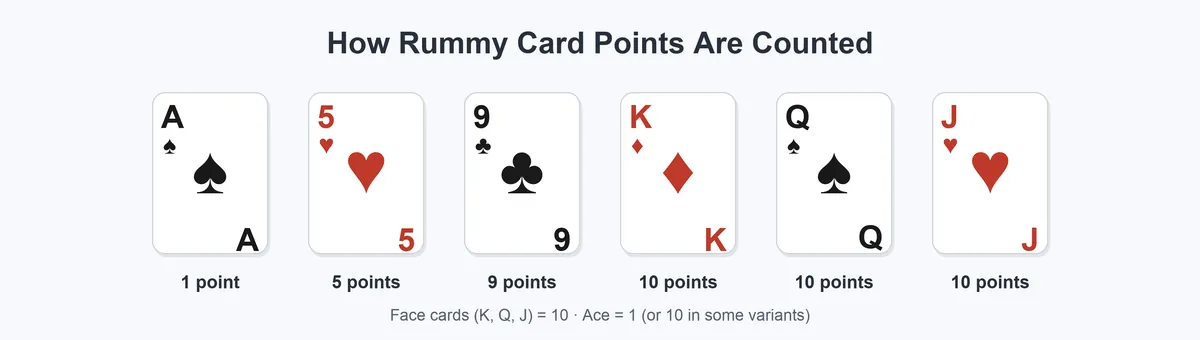
Almost every Rummy variant uses the same point values for cards. Learn this table once and you’re set:
| Card | Points |
|---|---|
| Ace | 1 (sometimes 10 or 15 — see below) |
| 2 through 10 | Face value (2–10) |
| Jack, Queen, King | 10 each |
| Joker / wild card | 0 |
The Ace is the one to watch. In basic Rummy and 13-card Indian Rummy it’s low and worth 1. In Rummy 500 a high Ace is worth 15. Agree on it before you deal.
Who Scores the Points?
This is where formats split. There are two broad systems:
1. Winner scores the losers’ cards (basic Rummy)
When one player goes out, the round ends and the winner collects the total value of every card still stuck in the other players’ hands. Your own unplayed cards are your enemy — they become someone else’s points.
2. Players score their own deadwood against them (Points / Indian Rummy)
In Points Rummy and 13-card Indian Rummy, the winner scores zero and everyone else is penalised the value of the unmatched cards left in their hand — usually capped (commonly at 80 points for a hand with no valid sequence). Lowest total wins.
3. You score the points you melded (Rummy 500)
In Rummy 500, you add the value of every card you laid on the table and subtract the cards left in your hand. First to 500 wins. Here, melding more is literally worth more.
4. Pool Rummy: penalty points until you’re knocked out
Pool Rummy stacks Points-Rummy hands into a survival game. Each hand’s penalty points add to your running total, and the moment you cross the pool limit — 101 or 201 — you’re eliminated. The last player left in the pool wins. It is the same per-hand counting as Points Rummy, just with a ceiling that ends your game.
Going Rummy: The Double
If you get rid of your entire hand in a single turn — melding everything at once, without having melded or laid off on any earlier turn — you’ve "gone rummy." Your score for that round is doubled. It’s risky, because holding your whole hand means big points if someone else goes out first, but the payoff is the best swing in the game.
Say a normal win would score you 24 points. Go rummy on that same hand and it becomes 48. The catch: to qualify you can’t have melded a single card on an earlier turn, so you sit on your whole hand — and if an opponent goes out first, all those held cards count against you instead.
Scoring in Gin Rummy
Gin Rummy has its own system built around deadwood (your unmatched cards):
- Knock: score the difference between your deadwood and your opponent’s.
- Gin (zero deadwood): score the opponent’s deadwood + a 25-point bonus.
- Undercut: if the opponent ties or beats the knocker’s deadwood, they score the difference + 25.
- Play continues until a player reaches 100 points, then line and game bonuses are added.
Keeping Score on Paper
You don’t need an app to keep score. Draw one column per player. After each hand, write down the points that hand awarded — the winner’s tally in winner-scores formats, or each loser’s deadwood in Points and Indian Rummy — and keep a running total at the foot of each column. In winner-takes formats the highest total after the agreed number of hands wins; in deadwood formats the lowest total wins. Write the target score at the top so nobody forgets when the game ends.
Quick Reference: Scoring by Format
| Format | Who scores | Game target |
|---|---|---|
| Basic Rummy | Winner takes losers’ card values | Agreed total |
| Points Rummy | Losers penalised own deadwood | Per-hand |
| 13-Card Indian Rummy | Losers penalised own deadwood (capped) | Agreed total / pool |
| Rummy 500 | Each scores melds minus hand | 500 points |
| Gin Rummy | Lower deadwood scores the difference | 100 points |
Frequently Asked Questions
How are points counted in Rummy?
Number cards score their face value, face cards (J, Q, K) are 10 each, and Aces are usually 1. In basic Rummy the winner scores the total of the cards left in the losers’ hands.
How much is an Ace worth?
Usually 1 point. In Rummy 500 a high Ace (Q-K-A or a set) is worth 15. Always confirm before the deal.
What does going rummy do to your score?
Melding your whole hand in one turn — without melding or laying off earlier — doubles your score for that round.
Do jokers have a point value?
When used as a wild card in a meld, a joker scores 0. If you’re caught holding one in some Indian Rummy variants it can carry a penalty — check your house rules.
How do you win a game of Rummy?
It depends on the format: reach an agreed target, score the lowest penalty total, or be first to 500 in Rummy 500. See the table above.