Gin Rummy with 3 Players: Rules and Rotation Explained
Gin Rummy is famously a two-player game — so what do you do when a third person wants in? You don’t have to leave anyone out. The standard gin rummy rules for 3 players keep the classic head-to-head hand intact and simply rotate who plays and who sits out. Here’s exactly how three-handed Gin Rummy works, who deals, and how the scoring adds up.

Can You Play Gin Rummy with 3 Players?
Yes — with one important catch. A single hand of Gin Rummy is always two players head-to-head, because the whole game is built around reading one opponent’s discards and hidden melds. To bring in a third player you don’t deal three hands; instead, the three of you take turns, with one person sitting out each hand. If you’re new to the game, start with the how to play Gin Rummy guide first, then add the rotation below.
Play Gin Rummy free while you learn No signup, no download — get the two-player hand down first, then bring in a third. Play Gin Rummy →The Rotation: How Three Players Take Turns
This is the heart of three-handed Gin Rummy, sometimes called Cutthroat Gin or Round Robin Gin. Think of it as "winner stays on":
- Choose the first dealer. One of the three players deals the opening hand and sits out — they don’t play that hand.
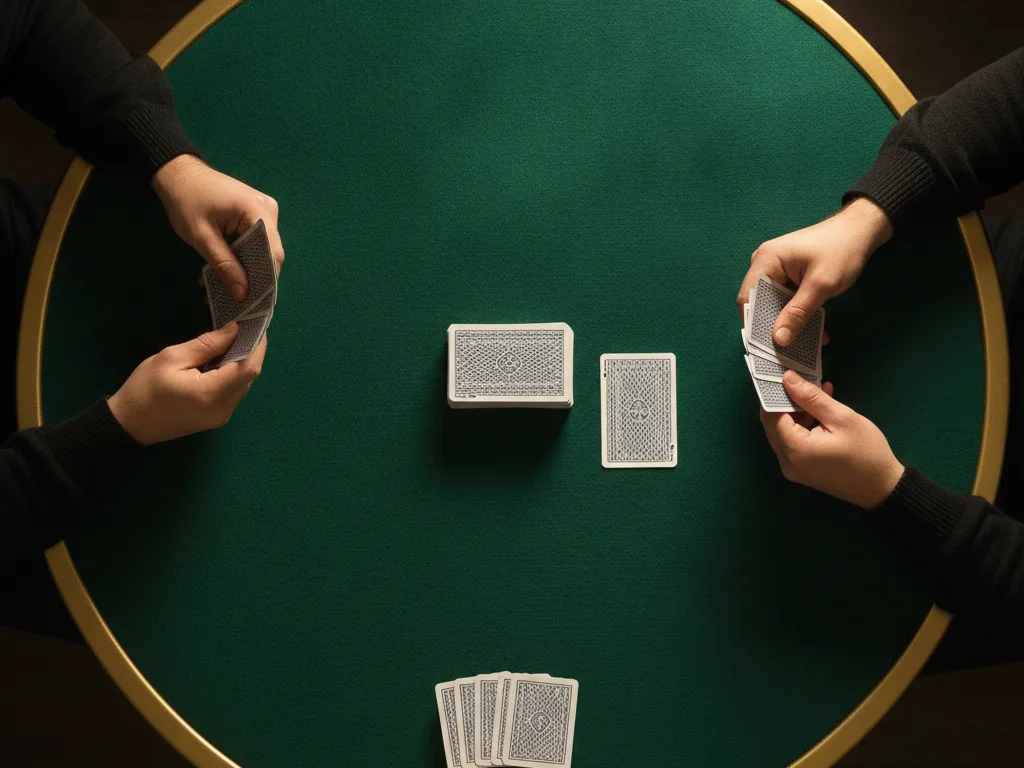
- The other two play a normal hand. Deal them 10 cards each and play standard Gin Rummy: draw, discard, and knock or go gin when ready.
- Score the hand. The winner adds their points to their own running total (more on scoring below).
- Rotate. The loser sits out the next hand and becomes the new dealer. The player who sat out comes in to face the winner.
- Repeat. Keep going so the winner of each hand stays at the table and the loser rotates out.
Because the winner keeps playing, a hot streak is rewarded — but everyone cycles through, so no one waits long. Each player keeps their own cumulative score the whole time.
Setup at a Glance
| Item | Detail |
|---|---|
| Players | 3 (two active, one sitting out each hand) |
| Deck | One standard 52-card deck |
| Cards dealt | 10 each to the two active players |
| Dealer | The player sitting out that hand |
| Aces | Low (worth 1 point) |
| Target score | Usually 100 points |
Scoring with Three Players
The good news: scoring doesn’t change at all. Every hand is scored exactly like the two-player game, so all of the gin rummy scoring rules apply:
- Knock: end the hand with 10 or less deadwood and score the difference between the two players’ deadwood.
- Gin: zero deadwood earns a 25-point bonus plus your opponent’s deadwood.
- Undercut: if the defender’s deadwood is equal or lower after laying off, they score 25 plus the difference.
The only difference is bookkeeping: keep three separate columns, one per player, and add each hand’s points to the winner’s column. The first player to reach 100 points wins the game, after which you can add line and game bonuses if you’re playing the full scoring.
A Quick Example
Say Ana, Ben and Cara sit down. Cara deals first and sits out. Ana beats Ben by knocking for 12 points — Ana now has 12. Ben lost, so he sits out and deals the next hand; Cara comes in to play Ana. Cara goes gin and scores 30 — Cara now has 30, Ana stays on 12. Ana lost, so Ana sits out and deals; Ben returns to face Cara. Play continues like this until someone crosses 100.
An Alternative: Three-Hand Simultaneous Gin
Some groups prefer a version where all three play at once. Each player is dealt 10 cards from the same deck, and when someone knocks or goes gin, both opponents compare deadwood against the knocker and pay separately. It’s faster and keeps everyone involved every hand, but it loses some of the one-on-one tension that makes Gin Rummy special. The rotation method above is the more traditional and widely used choice — agree on which you’re playing before you deal.
Can 4 People Play Gin Rummy?
Yes, and four is where Gin Rummy opens up into partnership play. Split into two teams of two, seated so partners sit opposite each other. Each team plays a separate two-handed game against the other team; after each hand, partners add their scores together for a combined team total, and the first side to the target (often 125 for partnership Gin) wins. If you’d rather everyone play for themselves, you can also run the same sit-out rotation as above with four people — two play, two wait — though the wait between hands gets longer. For a quick group, the three-player rotation is the smoother ride.
Tips for Three-Handed Gin
- Use your sit-out hand. When you’re dealing and watching, note which cards each player picks up from the discard pile — that intel helps when you rotate back in.
- Knock a little sooner when you’re behind. Banking a modest knock keeps you on the table and denies the leader easy points.
- Push for gin when you’re the one to beat. If you’re the winner staying on, a gin bonus stretches your lead before a fresh opponent arrives.
- Watch the scoreboard, not just the hand. With three running totals, sometimes it’s worth playing safe to stop a rival reaching 100.
Frequently Asked Questions
Can you play Gin Rummy with 3 players?
Yes. Gin Rummy is a two-player game at heart, so with three players you rotate: two play a normal hand while the third sits out and deals, then players swap in and out between hands. Each player keeps their own running score.
Who deals in three-player Gin Rummy?
The player sitting out a hand is the dealer for that hand. After each hand the loser sits out and becomes the next dealer, while the player who sat out comes in to play the winner.
Is the scoring different with three players?
No. Each hand is scored exactly like two-player Gin Rummy — deadwood difference, a 25-point gin bonus and 25-point undercut bonus. The only change is that all three players keep separate cumulative totals.
How many cards are dealt in three-player Gin Rummy?
Ten cards each to the two active players, the same as the standard two-handed game. The player sitting out is not dealt a hand.
Can 4 people play Gin Rummy?
Yes. With four players the usual format is partnership Gin: two teams of two, each partnership playing a separate two-handed game and adding their scores together. You can also use the same sit-out rotation as three players, with two active and two waiting.