How to Play Gin Rummy: Full Rules for 2 Players
Gin Rummy is the sharp, two-player cousin of classic Rummy. Instead of laying melds on the table as you go, you keep your hand hidden and end the round in one decisive move — a knock. It plays fast, rewards patience, and is one of the best card games for two people. This guide covers every rule, from the deal to the final score of 100.
Play Gin Rummy free while you read No signup, no download — open the game in another tab and try each rule as you learn it. Play Gin Rummy →The Goal of Gin Rummy
Gin Rummy is played by two people with a standard 52-card deck. Your aim is to organise your hand into melds — sets and runs — while keeping the value of your leftover, unmatched cards (called deadwood) as low as possible. When your deadwood is low enough, you "knock" to end the hand and score the difference against your opponent. The first player to reach 100 points over a series of hands wins the game.
How Many Cards in Gin Rummy?
Each player is dealt 10 cards. The next card is turned face up to start the discard pile, and the remaining cards form the face-down stock. The non-dealer gets the first chance to take that upcard; if they pass, the dealer may take it; if both pass, the non-dealer draws from the stock and play begins.
Gin Rummy Melds: Sets and Runs
As in all Rummy games, there are two kinds of meld:
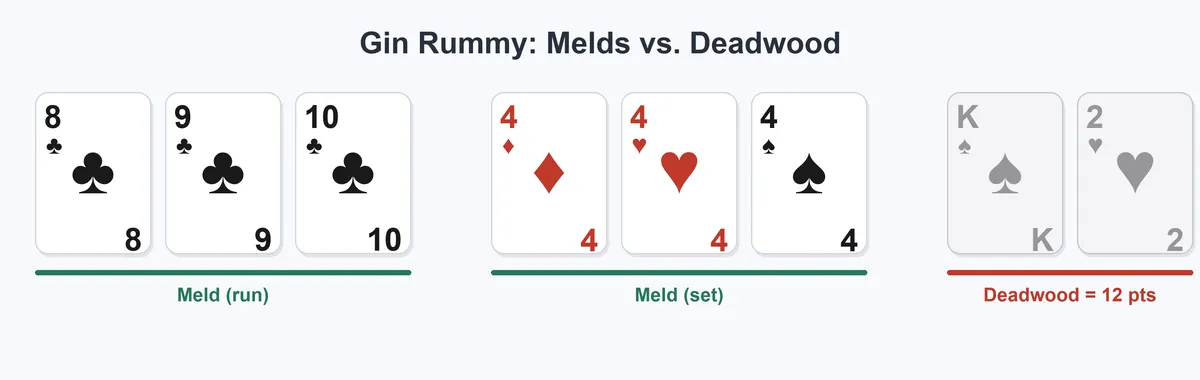
- Set — three or four cards of the same rank, e.g. 7♥ 7♠ 7♣.
- Run — three or more cards of the same suit in sequence, e.g. 4♦ 5♦ 6♦.
A card can only belong to one meld at a time. Aces are low, so A-2-3 is a valid run but Q-K-A is not.
Card Values & Deadwood
Deadwood is the total point value of the cards in your hand that aren’t part of any meld:
| Card | Value |
|---|---|
| Ace | 1 point |
| 2 through 10 | Face value (2–10) |
| Jack, Queen, King | 10 points each |
The whole game is a race to push your deadwood down. The lower it is, the safer it is to end the hand.
A Gin Rummy Turn
On each turn you take exactly two actions:
- Draw one card — either the unknown top of the stock or the visible top of the discard pile (you now hold 11 cards).
- Discard one card face up onto the discard pile (back to 10 cards).
Unlike in basic Rummy, you do not lay melds down during play. Everything stays hidden in your hand until someone ends the round.
Knocking and Going Gin
You can choose to end the hand on your turn, after drawing and before discarding, in one of two ways:
Knocking
You may knock when your deadwood totals 10 points or fewer. You lay your hand down, arranged into melds with your deadwood separate, and discard your final card face down.
Going Gin
If all ten of your cards form melds and your deadwood is zero, you’ve "gone gin." This earns a 25-point bonus on top of your opponent’s deadwood, and it cannot be undercut.
Scoring a Hand
Once a player knocks, the opponent gets to lay off — they may add their own deadwood cards onto the knocker’s melds to reduce their count (this is not allowed against a gin hand). Then you compare:
- Knock won: the knocker scores the difference between the two deadwood totals.
- Gin: the gin player scores the opponent’s deadwood + a 25-point bonus.
- Undercut: if the opponent’s deadwood is equal to or lower than the knocker’s, they undercut — scoring the difference plus a 25-point bonus instead. Knocking with a high count is risky for exactly this reason.
Hands are played until one player reaches 100 points, usually with extra line and game bonuses added at the end.
A worked example of a knock
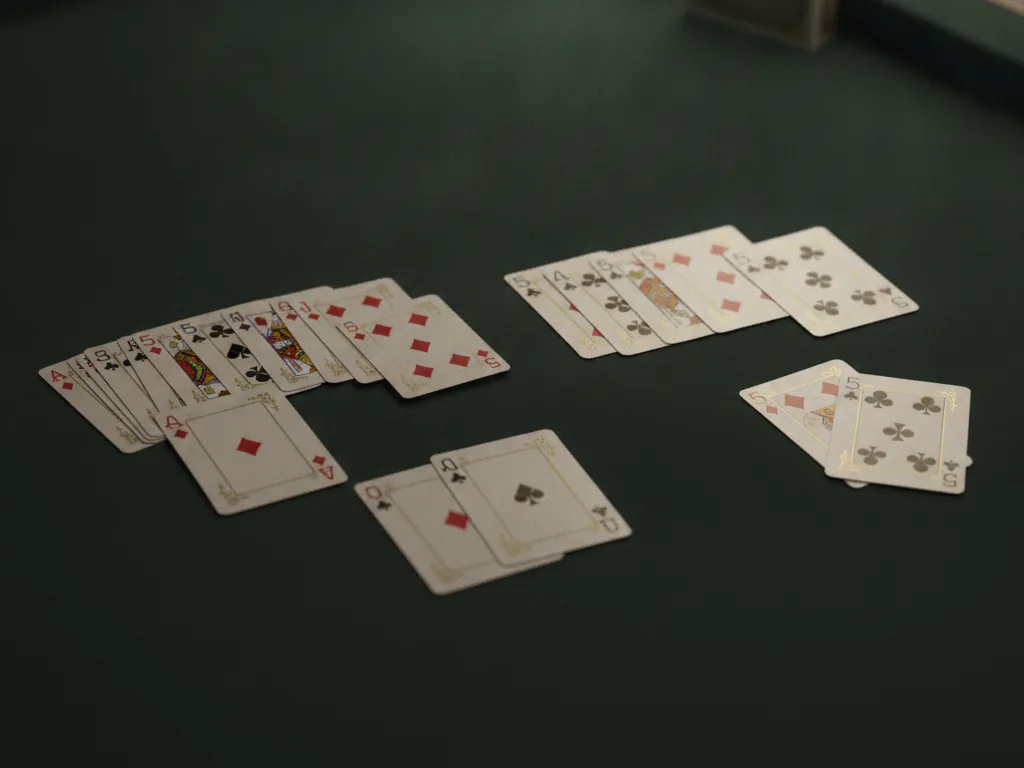
Say you knock with 8 deadwood (an unmatched 5 and a 3). Your opponent has melded most of their hand but is left with 14 deadwood. First they lay off whatever they can onto your melds — suppose they shed a card to drop to 11. You then score the difference: 11 − 8 = 3 points. A thin margin — and if their lay-offs had dropped them to 8 or below, they would have undercut you and scored 25 + the difference instead. That risk is exactly why a low, safe knock beats a greedy one.
Gin Rummy Variations Worth Knowing
Once the standard game clicks, two variants change how you score:
- Oklahoma Gin. The card turned up at the start of each hand sets that hand’s knock limit — if a 6 shows, you can only knock with 6 or fewer deadwood. When an ace shows, you must go gin to end the hand, which makes for a tense round.
- Hollywood Gin. Not a rule change but a scoring format: you track three games at once across three columns, and each win banks points in more than one game. It turns a quick session into a longer match.
Gin Rummy Strategy: How to Win
- Knock early when you can. A small, safe lead banked now often beats waiting for gin and getting undercut.
- Watch the discards. What your opponent takes and throws tells you which melds they’re building — stop feeding them.
- Hold flexible middle cards. A 6 or 7 fits more runs than an Ace or King.
- Dump high deadwood early. Face cards are 10 points of risk sitting in your hand.
- Count the deadwood you can see. If you suspect the opponent is close, knock before they do.
Frequently Asked Questions
How many cards do you get in Gin Rummy?
Each of the two players is dealt 10 cards. One card starts the discard pile and the rest form the stock.
What does it mean to knock?
Knocking ends the hand. You may knock when your unmatched cards (deadwood) total 10 points or fewer, then score the difference against your opponent.
What's the difference between knocking and going gin?
You can knock with up to 10 deadwood. Going gin means zero deadwood — every card is melded — which earns a 25-point bonus and can’t be undercut.
Can you play Gin Rummy with more than 2 players?
Gin Rummy is built for two. For three or four players, classic Rummy or Rummy 500 work better.
What's the difference between Rummy and Gin Rummy?
In Rummy you lay melds on a shared table as you go. In Gin Rummy melds stay hidden and the hand ends with a single knock.