15 Rummy Tips & Tricks to Win More Games (2026)
Rummy rewards skill — memory, planning and reading the table — so better decisions really do win more hands over time. What they don't do is guarantee any single game; rummy is skill plus variance. These 15 tips will sharpen your decisions and lower your average loss, and the best part is you can drill every one of them for free, with no money at risk.
Foundation: Get These Right First
1Build a pure sequence before anything else
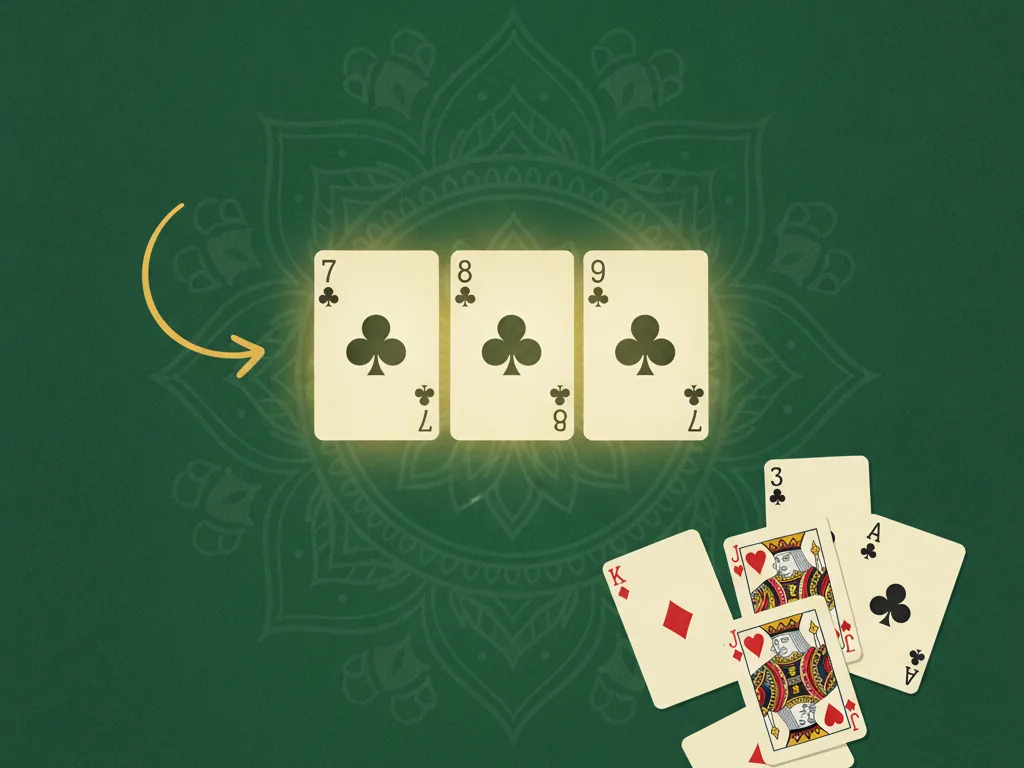
A pure sequence — three or more cards of the same suit in order, with no joker — is mandatory for a valid declaration. Make it your first goal every hand. Until you have one, you're exposed to a heavy loss if an opponent declares.
2Discard high-value cards early
Aces, kings, queens and jacks carry the most points if you lose. Unless they're part of a forming meld, let them go in the first few turns — holding them is a big risk for a small upside.
3Learn the card values cold
You can't manage risk you can't count. If you're shaky on point values, review our rummy scoring guide until it's second nature.
Reading the Table
4Watch what opponents pick from the discard pile
Every card an opponent takes from the open pile tells you which sets and runs they're building. Use it to avoid feeding them the cards they need.
5Track what's been discarded
If two of a card you need are already in the discard pile, the odds of completing that meld are slim. Pivot early rather than waiting on a near-dead card.
6Don't telegraph your hand
Avoid picking from the open pile unless it clearly helps — it reveals your plans. When two discards are equal, prefer the one that gives opponents the least information.
Jokers & Melds
7Use jokers on high-value melds
A joker is most valuable completing a set or run of high cards, where it removes the most points from your hand. Don't waste one where low cards would do.
8Never use a joker in your pure sequence
By definition a pure sequence has no joker. Save jokers for impure sequences and sets instead.
9Keep your melds flexible
Hold cards that can join more than one combination (middle cards like a 6 or 7) longer than dead-end cards — they give you more ways to complete.
Decision-Making & Probability
10Think in odds, not hope
Ask "how many cards complete this meld, and how many are still live?" rather than hoping the one you want appears. Keep the draws with more outs; drop the ones with few.
11Know when to drop
If your opening hand is poor and your format allows a drop, taking a small fixed penalty early can beat risking a full high-point loss. A disciplined drop is a skill, not a surrender.
12Reduce points even when you can't win
Once winning looks unlikely, switch to minimising your score — keep forming melds and shedding high cards so that if someone else declares, you lose as little as possible.
Habits That Compound
13Sort and re-sort your hand
Keep your cards organised by suit and potential meld. A tidy hand prevents missed sequences and silly discards under time pressure.
14Practise deliberately, one skill at a time
Pick a single focus — say, discarding high cards early — for a session, then review how it went. Targeted practice improves you far faster than playing on autopilot.
15Master the game for free before any stakes
The cheapest way to get good is to practise where nothing is on the line. Drill these tips in a no-money game until they're automatic.
Practise every tip free — no risk Drill pure sequences, discards and joker play in our browser rummy game. No signup, no download, no stakes. Play Rummy free →Frequently Asked Questions
What is the most important rummy tip?
Form a pure sequence as early as possible — a valid declaration is impossible without one, so it should be your first priority every hand.
Is there a trick to always win at rummy?
No. Rummy is skill plus variance, so even perfect play loses some hands. Good strategy improves results over many games; nobody can guarantee a win.
How can I get better at rummy fast?
Practise deliberately in a free game, focus on one skill at a time, and review your decisions afterwards. Repetition with reflection beats playing on autopilot.
Should I hold or discard high-value cards?
Discard aces, kings, queens and jacks early unless they're part of a forming meld — they carry the most points if you lose.
Where can I practise these tips?
In our free browser rummy game — no money, no signup, no risk.