Indian Rummy: Rules, Formats and How to Play
Indian Rummy is the 13-card version of rummy that millions across India grew up playing at family gatherings and festivals. The aim is to arrange all 13 cards into valid sequences and sets — with at least one pure sequence — before anyone else. This guide covers the rules, what makes a valid declaration, jokers, the Points/Pool/Deals formats and scoring. Try every step in our free game as you read.
Play Rummy free while you read No signup, no download — open the game in another tab and practise forming sequences. Play Rummy →What Is Indian Rummy?
Indian Rummy (also called 13-card rummy) is a draw-and-discard game for 2 to 6 players. It uses two standard 52-card decks shuffled together with printed jokers. Each player is dealt 13 cards, and one card is turned up to pick a wild joker for the round. The first player to arrange all their cards into valid groups and declare wins the deal.
If you are completely new to rummy, start with our how to play Rummy guide for the basics, then come back here for the Indian 13-card rules.
The Goal: A Valid Declaration
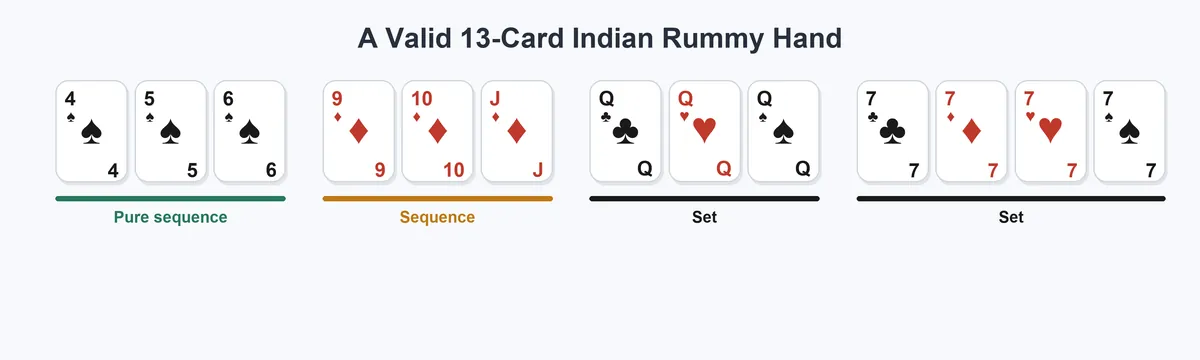
To win you must form a valid hand from all 13 cards, made of sequences and sets. Two rules decide whether your declaration counts:
- You need at least two sequences.
- At least one of them must be a pure sequence (no joker).
Here is what a valid 13-card hand looks like:
Sequences and Sets
- Pure sequence — three or more consecutive cards of the same suit with no joker, e.g. 4-5-6 of spades.
- Impure sequence — a sequence that uses a joker to fill a gap, e.g. 9-joker-J of hearts.
- Set — three or four cards of the same rank in different suits, e.g. three Kings. No two cards in a set may share a suit.
How Jokers Work
There are two kinds: the wild joker picked at random each round (every card of that rank becomes wild) and the printed joker. Either can replace a missing card in a set or an impure sequence — but never in your one required pure sequence.
How a Turn Works
- Draw a card from the closed deck (unknown) or the open discard pile (visible).
- Arrange your hand into sequences and sets, using jokers where helpful.
- Discard one card to the open pile to end your turn.
- Declare once your 13 cards are valid — place your final card in the finish slot and show your groups.
The Three Formats
Indian Rummy is played in three popular formats. The rules of the hand are the same; only how you score and win across deals changes.
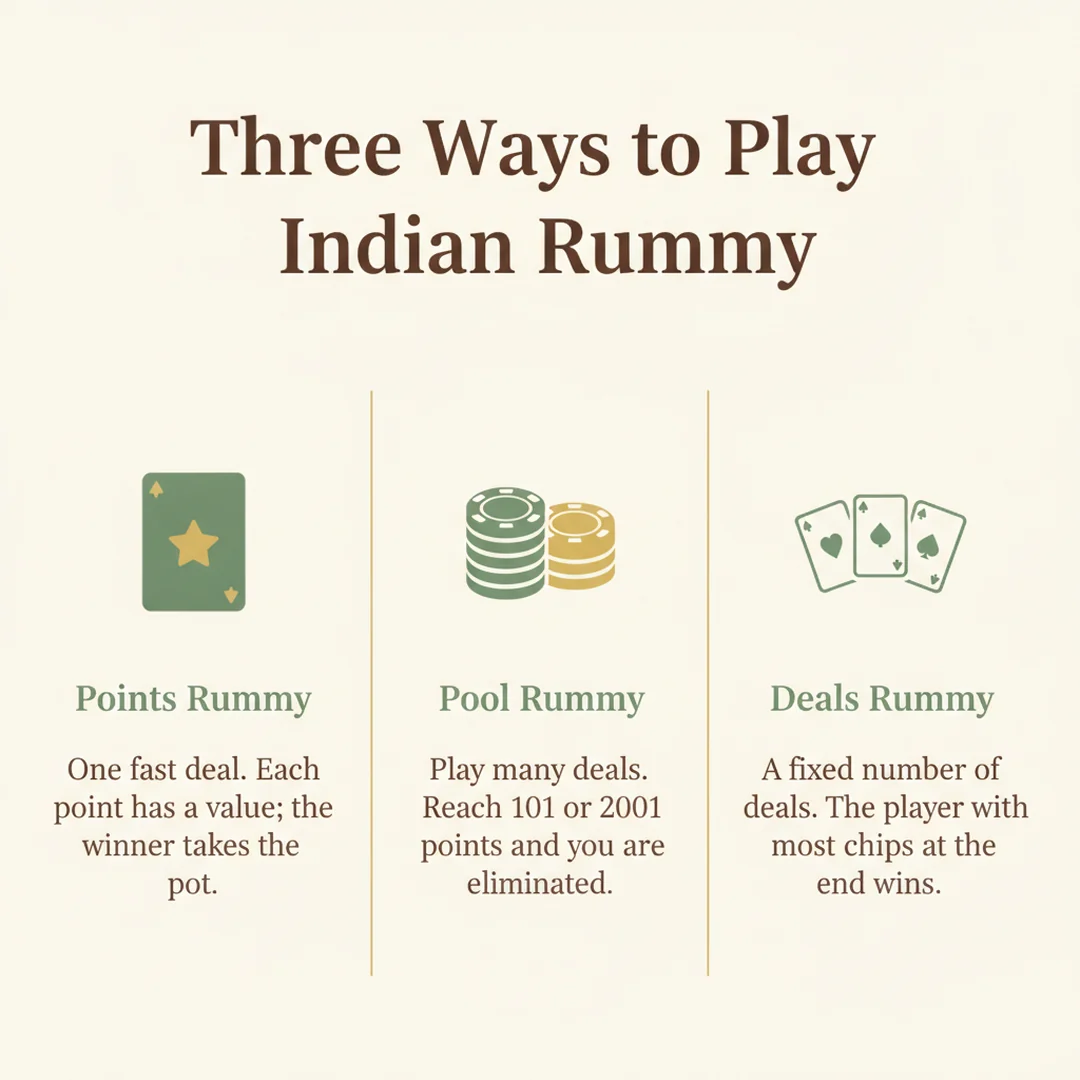
- Points Rummy — a single fast deal. Each point carries a value and the winner takes the round.
- Pool Rummy — played over many deals; your scores add up and you are eliminated when you cross the pool limit (101 or 201). The last player standing wins.
- Deals Rummy — a fixed number of deals; the player with the most chips at the end wins.
Scoring When You Lose
The winner scores zero. Everyone else adds up the value of the cards they couldn't meld:
| Card | Points |
|---|---|
| Number cards 2–10 | Face value |
| J, Q, K, Ace | 10 points each |
| Joker | 0 points |
A losing hand is capped at 80 points. If you declare without a valid hand (a "wrong show"), you take the full 80. The lesson: make your pure sequence first, then chase the rest. Our Rummy scoring guide explains point counting in more depth.
Indian Rummy vs Other Rummy Games
Indian Rummy's signatures are the 13-card hand, jokers, and the mandatory pure sequence. Classic Western Rummy deals fewer cards and lets you lay melds on a shared table; Gin Rummy keeps melds hidden and ends with a knock. For the full deep-dive on the Indian variant, see our 13-card Indian Rummy rules, and if you enjoy points-based openings, try Rummy 51.
Quick Tips to Win More
- Form your pure sequence as early as possible — without it, nothing else counts.
- Keep jokers for sets and impure sequences, not where a pure run can do the job.
- Let go of high cards (K, Q, J, Ace) you can't use — they cost 10 each if you lose.
- Watch the discard pile to read which cards your opponents need.
Frequently Asked Questions
How many cards are used in Indian Rummy?
It is a 13-card game played with two decks plus jokers, for two to six players. Each player is dealt 13 cards.
What is a pure sequence?
Three or more consecutive cards of the same suit with no joker. You must have at least one pure sequence to make a valid declaration.
What makes a declaration valid?
All 13 cards arranged into sequences and sets, with at least two sequences and at least one of them pure.
What are the formats of Indian Rummy?
Points Rummy (one quick deal), Pool Rummy (eliminated at 101 or 201 points) and Deals Rummy (a fixed number of deals).
Is Indian Rummy the same as 13-card rummy?
Yes — "Indian Rummy" and "13-card rummy" are two names for the same game.