Rummy 51 Rules: How to Open with 51 Points
Rummy 51 takes the rummy you already know and adds one famous twist: before you can put any cards on the table, your first meld must be worth at least 51 points. That single rule changes how you plan your whole hand. This guide explains the setup, card values, the 51-point opening, jokers and scoring — with clear examples you can try in our free game.
Play Rummy free while you read No signup, no download — open the game in another tab and practise melding as you learn. Play Rummy →What Is Rummy 51?
Rummy 51 is a draw-and-discard rummy variant where the goal is the same as classic Rummy — get rid of all your cards by forming valid melds — but you are not allowed to start melding until you can lay down combinations totalling 51 points or more in one turn. This is called opening.
One quick note before the rules, because the name is used for two different things in India:
- Rummy 51 (the rule) — the variant explained on this page, where your first meld must reach 51 points.
- "Rummy 51 bonus" apps — a real-money sign-up promotion (a small ₹51 credit) on some cash apps. That is a marketing offer, not a rule. RummyFun is a free, just-for-fun game with no real-money play, so this guide sticks to the actual rules.
Setting Up the Game
- Players: 2 to 4.
- Cards: two standard 52-card decks shuffled together, plus jokers.
- Deal: each player is usually dealt 13 cards (some versions deal 14). The rest form the face-down stock, and the top card is turned over to start the discard pile.
Card Point Values
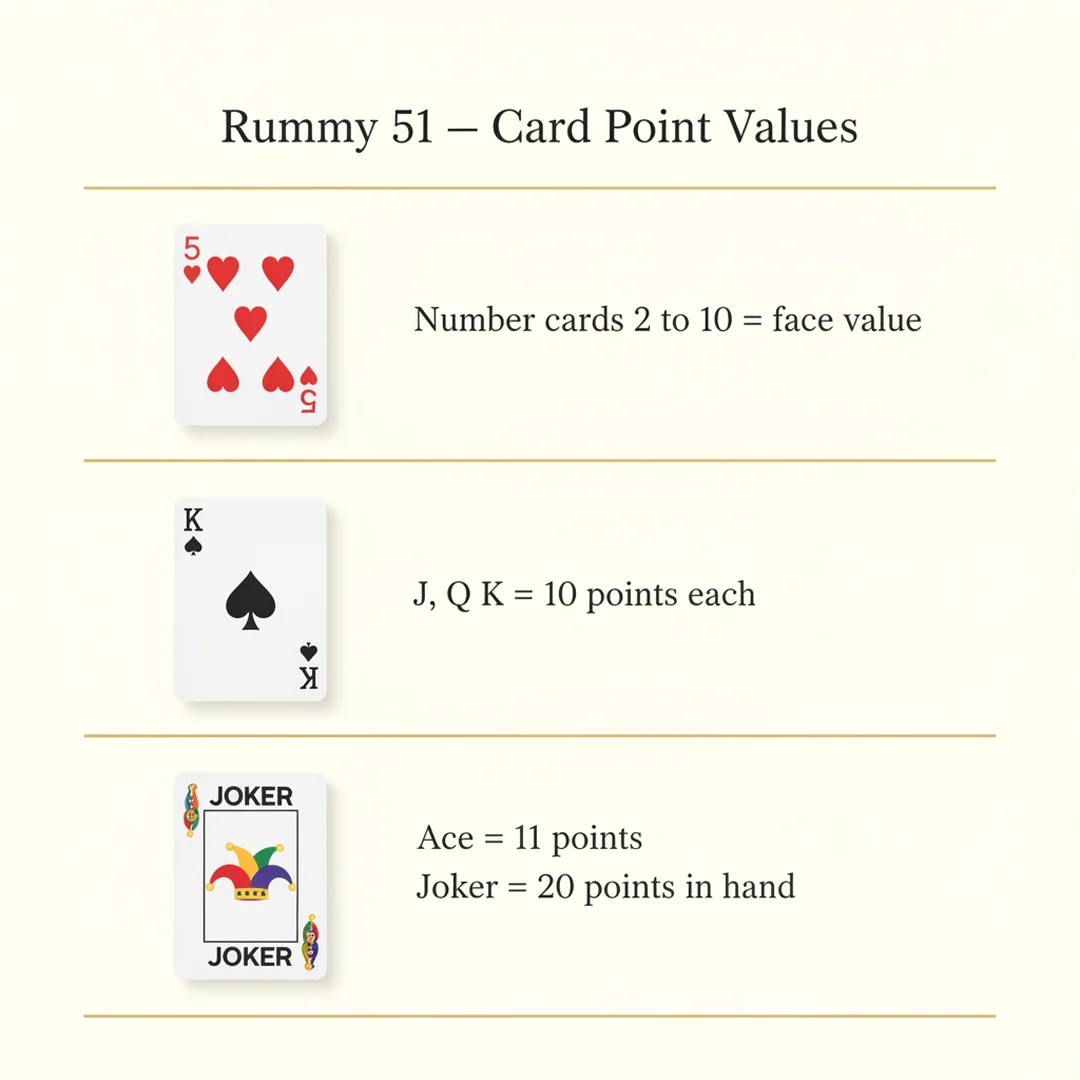
The whole game turns on points, so learn these first:
| Card | Value |
|---|---|
| Number cards 2–10 | Face value (a 7 = 7 points) |
| Jack, Queen, King | 10 points each |
| Ace | 11 points |
| Joker | Takes the value of the card it replaces (counts as 20 in your hand if unused) |
Melds: Sets and Runs
Just like every rummy game, you build two kinds of meld:
- Run (sequence) — three or more cards of the same suit in order, for example 5-6-7 of hearts.
- Set (group) — three or four cards of the same rank in different suits, for example three Kings. A set cannot contain two cards of the same suit.
Jokers are wild and can stand in for a missing card in either kind of meld. For a refresher on the basics, see our how to play Rummy guide.
The 51-Point Opening Rule
This is the heart of the game. The first time you lay cards on the table, the melds you put down must total at least 51 points, all in a single turn. If you can't reach 51 yet, you keep drawing and discarding until you can.
Here is a clean example that lands on exactly 51:
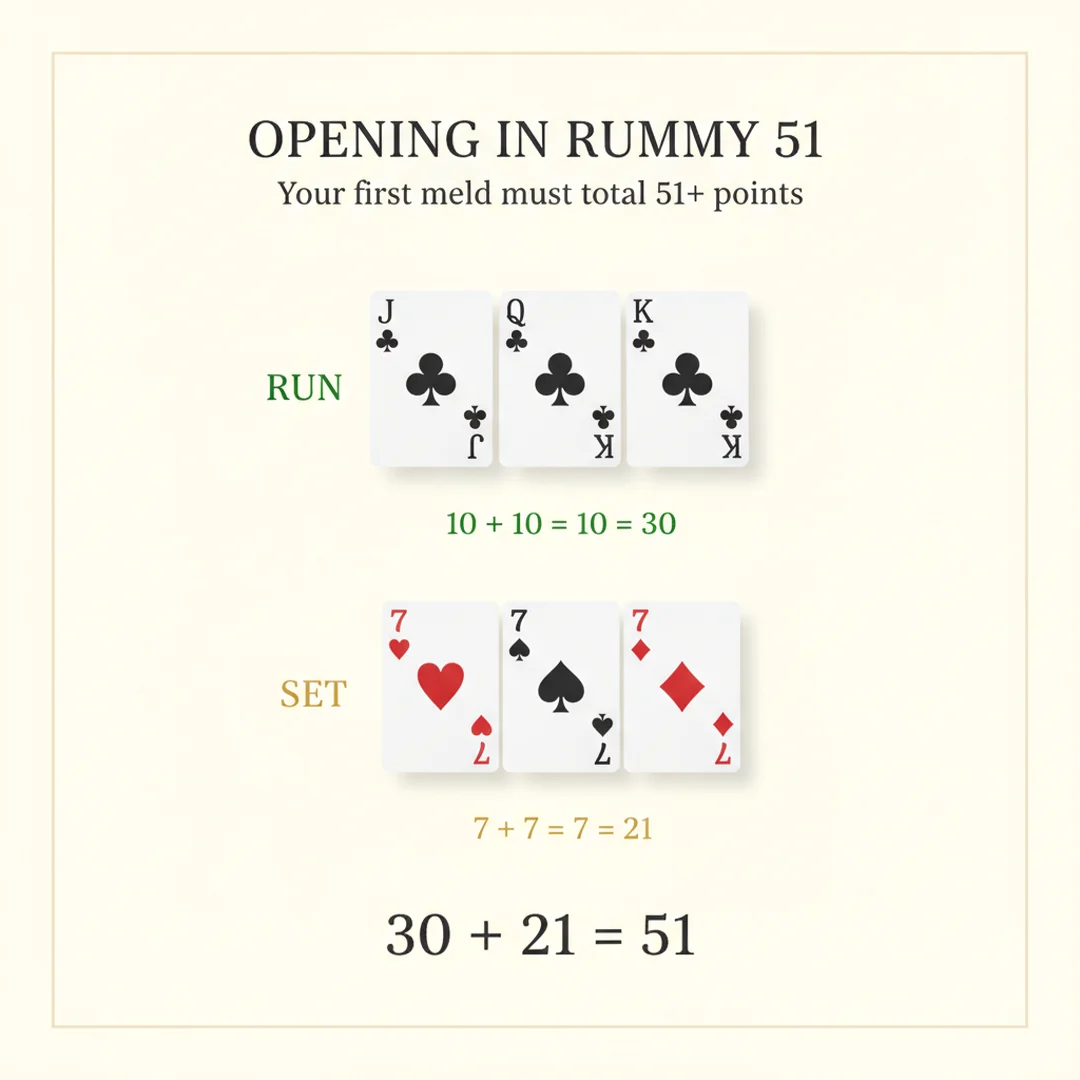
Two things to remember about opening:
- Until you have opened, you cannot lay off cards onto other melds either — the 51-point meld must come first.
- After you open, the cap is lifted: on later turns you can lay down any valid meld and lay off single cards freely.
How a Turn Works
On your turn you follow three steps:
- Draw one card — the unknown top of the stock, or the visible top of the discard pile.
- Meld (optional) — open with 51+ points if you can, or, once open, lay down more melds and lay off cards onto existing ones.
- Discard one card to end your turn.
Winning and Scoring
The round ends when one player melds their whole hand and discards their final card — that player wins. Everyone else is penalised by the point value of the cards still in their hand, using the values in the table above. A player who never managed to open is usually left holding the most points, which is exactly why the 51 rule makes the game tense.
Across several rounds, the lowest total score wins. If you like keeping score, our Rummy scoring guide walks through counting points in detail.
Rummy 51 vs 51 Pool Rummy
In India you will also see 51 Pool Rummy, and it trips a lot of players up because the number is the same but the rule is completely different. 51 Pool Rummy is standard 13-card Indian Rummy played as a "pool", where your scores from each deal add up and you are knocked out when your total reaches the pool limit. So here "51" is an elimination threshold, not an opening requirement.
The quick way to keep the two apart:
| Rummy 51 (the meld rule) | 51 Pool Rummy | |
|---|---|---|
| What "51" means | Your first meld must total 51+ points | You are out when your score reaches 51 |
| Base game | Draw-and-discard rummy, 2 decks | 13-card Indian Rummy, 2 decks |
| Cards dealt | 13 (sometimes 14) | 13 |
| Goal each deal | Open with 51, then empty your hand | Make a valid 13-card show with a pure sequence |
| You lose when | You hold the most points at the show | Your running total hits the 51 pool cap |
51 Pool Rummy rules in brief
If your table is playing the pool format, here is the short version:
- Each player is dealt 13 cards and a random card becomes the wild joker for the deal.
- To make a valid show you need at least two sequences, one of which must be a pure sequence (a run with no joker), and the rest of your cards arranged into valid sets or runs.
- At the end of each deal the loser carries forward penalty points (capped at 80 for a wrong show / first drop rules vary).
- The moment a player’s cumulative score reaches 51 or more, they are eliminated.
- The last player left standing — the one who never crosses 51 — wins the pool.
101 Pool and 201 Pool work the same way with higher caps and longer games. The takeaway: same number, two very different rules, so check which one your table means before you sit down. If you want the full 13-card show rules, our 13-card Indian Rummy guide covers them in detail.
Free Printable Rummy 51 Rules (Cheat Sheet)
Learning at the table? Here is a one-glance summary you can keep beside you. To save it as a PDF or print it, just press Ctrl + P (or Cmd + P on a Mac) on this page and choose “Save as PDF” — the menus, ads and buttons drop away and only this clean cheat sheet prints.
♠ Rummy 51 — Quick Rules Card
2–4 players · two decks + jokers · 13 cards each
- Open with 51: your first melds must total at least 51 points in one turn.
- Card values: 2–10 = face value · J/Q/K = 10 · Ace = 11 · unused Joker = 20.
- Run: 3+ cards, same suit, in order (e.g. 5-6-7♥).
- Set: 3–4 cards, same rank, different suits (e.g. three Kings).
- Jokers are wild and take the value of the card they replace.
- Turn: Draw → meld/lay off (only after opening) → discard.
- No lay-offs until you have made your 51-point opening.
- Win: empty your hand first; everyone else loses the points still in theirs.
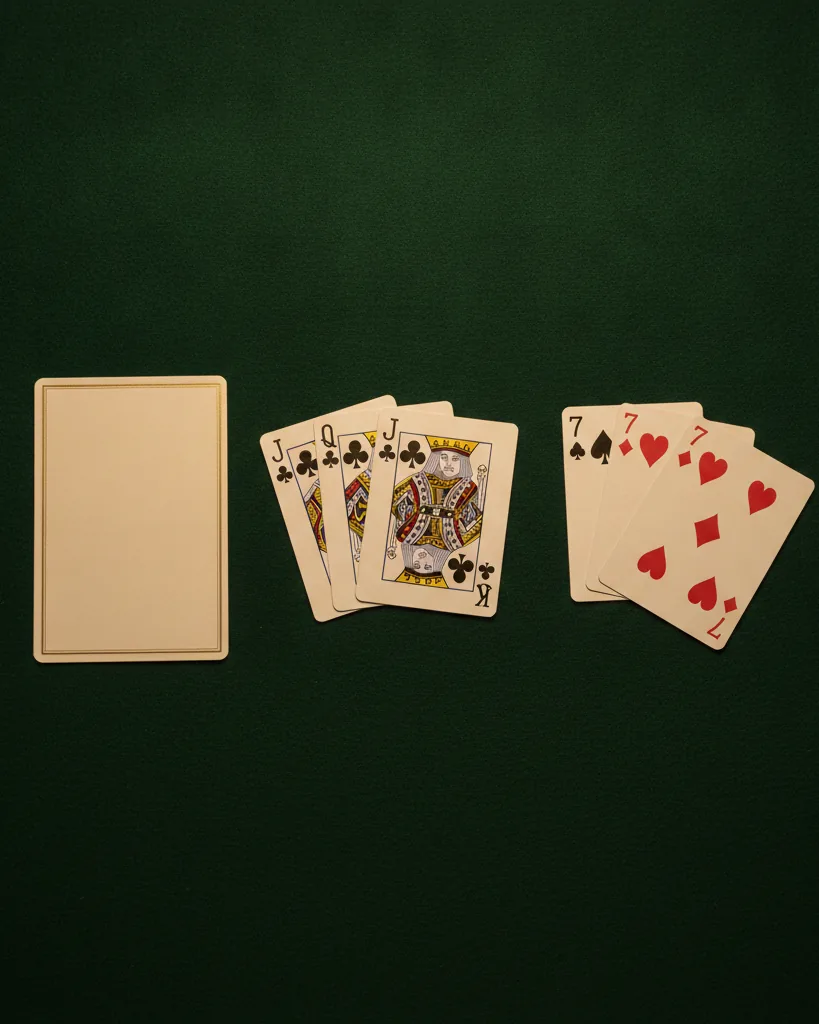
- Sample opening: J-Q-K (30) + three 7s (21) = 51. ✓
Quick Tips to Win More
- Aim your early draws at one big opening meld rather than several small ones — you need 51 in a single turn.
- High cards (K, Q, J, Ace) help you reach 51 faster, but they also cost the most if you're caught holding them.
- Save a joker to complete the meld that gets you over the line.
- Watch what opponents discard — it tells you which sets and runs they are chasing.
Frequently Asked Questions
What does 51 mean in Rummy 51?
It is the opening requirement: the first melds you lay on the table must total at least 51 points, placed in a single turn. Until you reach 51 you cannot lay anything down.
How many cards are dealt in Rummy 51?
It uses two decks plus jokers for two to four players, and each player is usually dealt 13 cards. Some versions deal 14.
How many points is each card worth?
Number cards score their face value, J/Q/K score 10 each, and the Ace scores 11. A joker takes the value of the card it replaces and counts as 20 in your hand if unused.
Is Rummy 51 the same as a ₹51 bonus app?
No. Rummy 51 is a rule about opening with 51 points. A ₹51 bonus is just a real-money sign-up promotion on some cash apps. RummyFun is free and has no real-money play.
Can I lay off cards before I open?
No. You must make your 51-point opening meld first. Only after opening can you lay off single cards onto melds.
What is 51 Pool Rummy and how is it different?
51 Pool Rummy is standard 13-card Indian Rummy played as a pool: scores add up over deals and you are knocked out when your total reaches 51. There the 51 is an elimination threshold, not an opening requirement — a completely different rule from the Rummy 51 meld variant on this page.
Is there a printable or PDF version of these rules?
Yes — use the free printable cheat sheet above. Press Ctrl + P (or Cmd + P on a Mac) and choose “Save as PDF”; the page hides the menus and buttons so only the clean rules card prints.